Blog

  • Looking Back to Surge Ahead

    Looking Back to Surge Ahead

    2023 in Review

    I started this blog during a short trip to Colorado this summer in the prayer that perhaps some day I would be able to expand it. In the last six months I have produced 61 posts totaling almost 95,000 words across many musings, thoughts, stories, and heartaches. That is, to me, immense. Some 700 people have visited the site in those six months, and it is my deep hope that each walked away with something of the Lord. To people who measure growth in thousands and millions, I am thankful that God has answered my prayer to have positive impact on even one other person and taken it much farther than that. We will go farther still, Lord willing.

    Deep Thankfulness

    I have been writing all my life, but only this year have I become serious about using that writing (and writing more) to try to reach out into the world and share and grow with others. There is vulnerability in the exposure, but freedom in the process as well. So, it is only right that I should thank many of the people who got me here, in no particular order.

    To Andrew and his wife Kayla, I cannot imagine having made it this far without some of the conversations we had during that week in Colorado. I praise the Lord for your marriage, your friendship and encouragement to me, and for the kick in the teeth that I needed to actually start this whole process. To Ian and Anna, but Ian especially (no offense, Anna, I’ve known him much longer) I want to say thank you for your critical eye, continuous contact, and unwavering support. You strengthen me with your feedback and challenges. Many new posts and ideas were sparked and honed from your difficult questions.

    To my sister, April, who has always been the first person who I sought feedback from, whose editorial eye and sense of storytelling I have regarded as of the very first class, thank you for being angry when I kill off a favorite character and insightful enough to know it was necessary (or kind enough to say so). Thank you for writing your own supporting post on your blog (hopefully the check finally cleared), and for all the difficult conversations about the nature of reality, storytelling, being men and women in a world gone mad, and for your faithfulness to God and as a mother. To my brother, Emmanuel, who has been an excellent example of the steadfast, persistent, hardworking man of God I often wish I could be and am striving to embody. You are the inspiration for some of my strongest characters and for me to grow deeper in the Lord.

    For my father who has become my rapid editor when I post something perhaps too quickly and fail to maintain even basic standards of the English language. More, to the father who raised me with many opportunities to grow as a man, hunting, shooting, camping out, pushing me to challenge myself physically and mentally. The father who, many years ago, despite his own misgivings supported me in leaving college to pursue mission work in a foreign country, and has since supported and trusted me through many difficulties: through surgery, through heartache, and through the joys and pains of wrestling with the Word of God.

    Finally, to my mother, by whose prayer and faithfulness, by the grace of God, I am where I am today. It is a truism that a Christian’s faith is most heavily influenced by his father, but there is no overstating the profound importance of my mom’s persistence in prayer for me when I was far from the Lord for many years, contending with myself, a dark world, and a depression she didn’t even know about. Now, years past the valley of the shadow of death, I am grateful for her excitement, joy, and exuberant love for the people around her and boundless curiosity. I am more grateful for those traits that I have taken from her, including interrupting people at coffee shops, bothering people on plane rides, and just generally being more outgoing than reserved, despite many years resisting those impulses. She is ever a light to people around her and a passionate defender of people.

    Next Steps

    With the spectre of a new year looming, what is next? Well, the Sibilant Sword is changing. I am slowly rolling out my Sagas of Siegyrd onto Royal Road to expand readership, and I stood up a Patreon where people can subscribe to get early access to new chapters, as well as opportunities to read posts early and provide feedback before they hit this blog. The Thirtieth chapter of Siegyrd is already written under the title “A Timeless Crystal Song.” It will post here on the 26th of December, but if anyone wants to read it early, they can subscribe and check it out on my Patreon.

    Additionally, after the New Year, a new story around Siegyrd will begin. The Dragon’s Daughter Arc will soon come to an end (which, as with all stories, lays the foundations for new beginnings). To tide us over until the next phase of storytelling, I have prepared Sagas of Siegyrd Origin Saga: The Last Sovereign where you will learn some of Siegyrd’s origins, what made him who and what he is. I have many other plans for the year, and will let you know as they come. 2024 is, to me, a year for building the next phase not only of the blog but of my life. It will be, Lord willing, my last year in my current job as I plan to transition to a whole new career path. It is exciting and terrifying, but I hope you will join me along the way.

    I am thankful for everyone who has read thus far and who continues to read, and for the one person, who I have never met, someone named Lisette, who gave me my first “tip” as an author here. Goodness is it nice to feel appreciated even in this small way for my work!

    Closing Remarks

    As Christmas comes and we are reminded of the Lord’s advent and then we step into a new year under His guidance, I pray you will take some time to consider what’s next for you and your family. I also pray you will bask in some sacred moments with those you love and worry little about what is to come and what was. You are still here on earth, and that is proof positive that the Lord has good and wonderful work for you to do for His kingdom. Don’t forget, His best blessings can only be enjoyed as long as it is called today. We live in no other time than this. Hold these tensions without giving in to them: the present moment and the eternity to come; the past and the future; and be thankful that God is molding you into His likeness.

    Merry Christmas, and a Happy New Year!

  • The Home to Come

    The Home to Come

    Walking through Denver International Airport is like an homage to all the places I have lived and been. B28 Honolulu – where I live for now. B20 San Diego – where I was only a week ago for Comic Con, and a month or so before that for work. B24 LA – a passthrough on many of my travels, but also a visit with my family almost ten years ago (the only memory one of crazy traffic packed between the twin beauties of mountains and ocean.) B18 Reno – where my family took a train trip to visit my mother’s friend when I was young. B26 Washington-Dulles – near my previous life in Northern Virginia, where I have flown through, worked, and met old friends who I found were no longer friends in the seeming blink of an eye. B23 Sioux Falls – where I graduated high school at seventeen then hopped in a camper to drive with my grandmother to Alaska to escape. B30 San Francisco – where the girl I wish I knew how to love still lives with her family. I still think of her often. And somewhere out there, within less than an hour’s drive of Denver are many friends I have made and memories in Colorado. B25 Minneapolis – the last place my best friend from High School lived before we lost touch ten years ago. I wonder where Brian is now. I pray he and his wife are well.

                   It feels like so much of my life inheres in the liminal spaces, train stations, lobbies, highways, byways, backroads, trams, and airports. Where I am is either a terminal between or a transport between. The whole of my existence has a sense of senseless movement. Even if I stand still, the terminals move around me. People, planes, trains, automobiles, and the unseen yet tangibly felt flow of time is a cold, enervating river.

                   I wonder if our deepening sense of loneliness is sourced in these sourceless masses of movement, the terminals that lie since they are not the true ends of anything, merely pauses in paths to we aren’t quite sure where. To reach the true terminus – the end – seems desirous. Perhaps it is my seemingly endless movement that makes me desire to complete things quickly. I am tired of the travel, the movement, the weary wanderings. I want to make an end, to have an end. Yet my life seems closer to a series of disconnected points in a cosmic terminal, stepping from one door to the next. No real start, no real end, no direction. Pulled in every direction at once.  

                   This terminal feels more like a mausoleum to my dead past than a pathway to my future. I am traveling from a wedding in Sanford, FL, where a man I met in Colorado, but stayed with in Kansas City, married a girl whose family originally came from some other place I do not know. Intersections and departures. B10 would take me back to Houston, a pass through on many previous journeys.

                   B11 heads to Tampa where I have spent time for work and was endlessly frustrated by the flat waters of a clear ocean bay hopeless in its tranquility. Behind me is B7 to Las Vegas where my sister and brother-in-law live with my two nieces, a third on the way, and where my oldest niece asked me last week why I had to leave and I almost lost it, felt my knees weak, ready to collapse right there on the living room rug.

                   I am more convinced every day that I am fragile like flash paper waiting for just a single spark to vaporize my being. Sometimes it feels like the only thing holding me together is a blackhole sadness in my chest which refuses to let the pieces of me escape its gravity – but I know that to be overly dramatic foolishness. The only thing holding me together is the Lord Himself. Christ by His Spirit has deigned to dwell in so ramshackle a soul and temple as this, though I trust He will make it beautiful in His perfect time.

                   B8 is Boise, the only place along the whole B terminal I have seen that I have not actually been to or passed through. I am both curious about it and disgusted at the thought of seeing one more new place without someone to share it with as if each new place is actually a burden to be carried and too much for just me.

                   I want so badly to go home that the very word home has a musical ring in it – a longing too deep for words. The concept of home has taken on a kind of mythical quality to me – perhaps because I have no idea what it means, but at its mention I have to fight with tears. I don’t have a place I can really call “home.” I have a place to sleep, by the grace of God, but home is concept almost foreign to me – a distant, fleeting, legendary, beautiful thing too impossible for me.

                   I once was a tree planted that hungrily reached for the depths of the new soil but was uprooted and replanted. In new earth I stretched out again, but slower than before. Then again, and slower. Again. Slower still. The most recent planting has been a creeping, tentative, wandering thirsting, fearful of the pain of another uprooting if I delve too deep or grow too tall.

                   It would be easy to think that there is nothing redeeming in this woeful wandering, but the Holy Spirit indicates otherwise in Hebrews 11 in the oft called Hall of Faith, “These all died in faith, not having received the things promised, but having seen them and greeted them from afar, and having acknowledged that they were strangers and exiles on the earth. For people who speak thus make it clear that they are seeking a homeland. If they had been thinking of that land from which they had gone out, they would have had opportunity to return. But as it is, they desire a better country, that is a heavenly one. Therefore God is not ashamed to be called their God, for he has prepared for them a city.”

                   Maybe you are out there, like me, hoping, longing, in fact begging for a home – for some stability.  I cannot promise that we will find such a thing on this side of eternity, but God has promised something better by far. In John 14:1-3 “Let not your hearts be troubled. Believe in God; believe also in me. In my Father’s house are many rooms. If it were not so, would I have told you that I go to prepare a place for you? And if I go and prepare a place for you, I will come again and will take you to myself, that where I am you may be also.”

                   Despite the pain and loneliness of my wayfaring lifestyle over the past fifteen years, I can and should be thankful for the great reminder it has been that we are strangers and sojourners on the earth, passing through only for a time until our Lord finishes preparation for the eternal home we will enjoy with Him. Whatever stability I feel I have lost, and long for, is a potent reminder of the promise of God that there will be a true home, a true city, and an eternal unity with Him in His house. Is not that worth the waiting through these light and momentary afflictions?

                   I earlier used the analogy of a tree being planted and uprooted multiple times, but that is a false analogy.  It is not I who is planted, but Christ, the root of Jesse, into whom I am grafted as a branch in His vine. While I may be moved from place to place, there is nothing that can sever me from that root, from the eternal, grounded, fundamental goodness and love of our gracious savior. By His immense mercy and love we “now share in the nourishing root of the olive tree.” (Romans 11:17)

                   Whatever the case for you, friends – whether you long for some sort of traveling adventure, are thankful for a stable earthly home, or anywhere in between – let us never forget that our true home is to come. We catch glimpses in the Church, in Godly families, and in faithful friends, but the fulfillment will be greater by far than the foretastes. Persevere. I say this more to myself, perhaps, than you, but persevere.

                   I started this post in a depth of despair, in spiraling complaints which I need to confess and be forgiven of, but here I end with gratefulness overflowing that we serve a good Lord who is willing and able to do impossibly more than we imagine. He is faithful when we are faithless, gracious in our weakness, and, in Himself, the truest home we will ever and forever possess. Praise Him today, and let not your hearts be troubled.

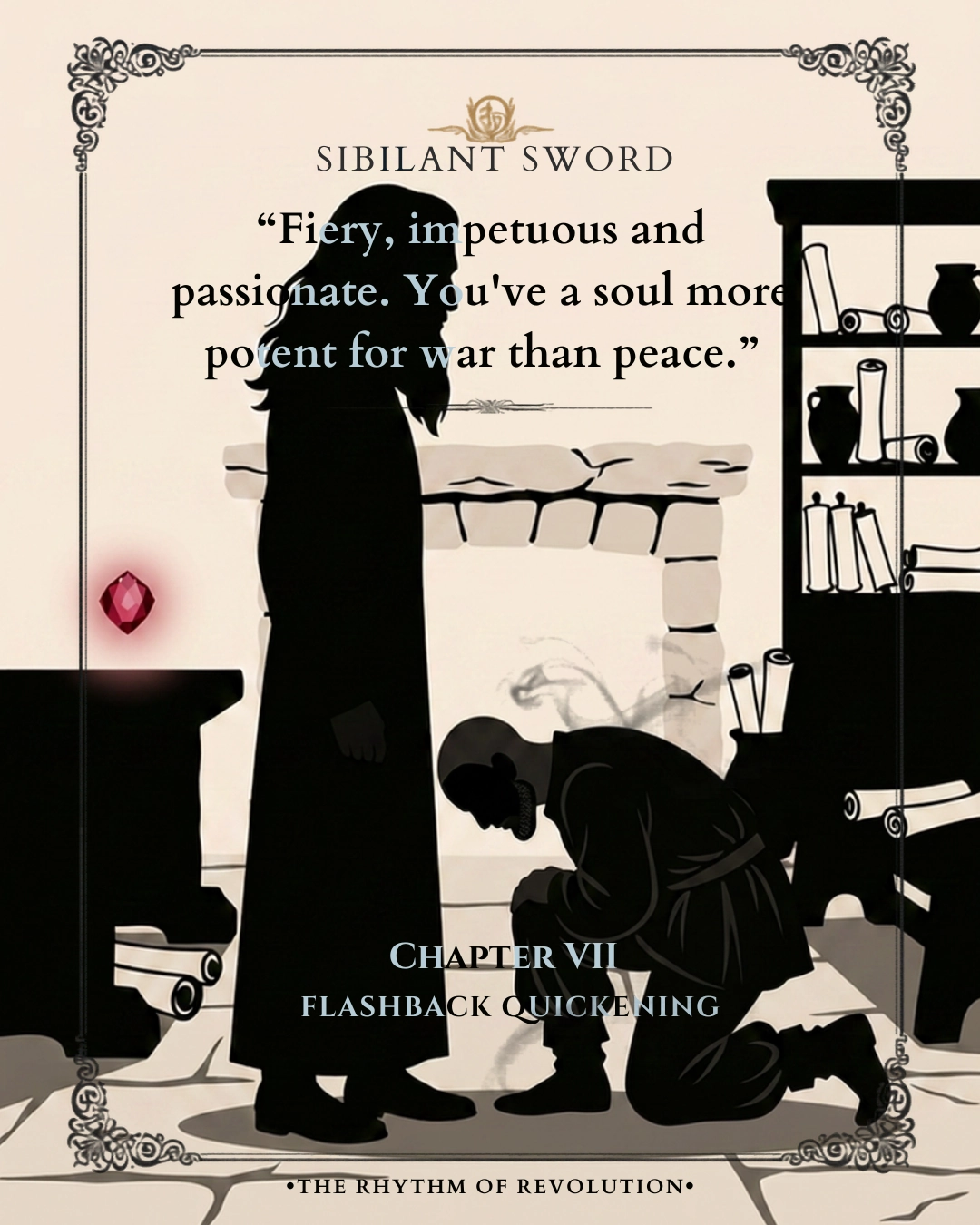
  • The Rhythm of Revolution Chapter 8

    The Rhythm of Revolution Chapter 8

    Subscribe to continue reading

    Subscribe to get access to the rest of this post and other subscriber-only content.

  • The Rhythm of Revolution Chapter 7

    The Rhythm of Revolution Chapter 7

    Subscribe to continue reading

    Subscribe to get access to the rest of this post and other subscriber-only content.

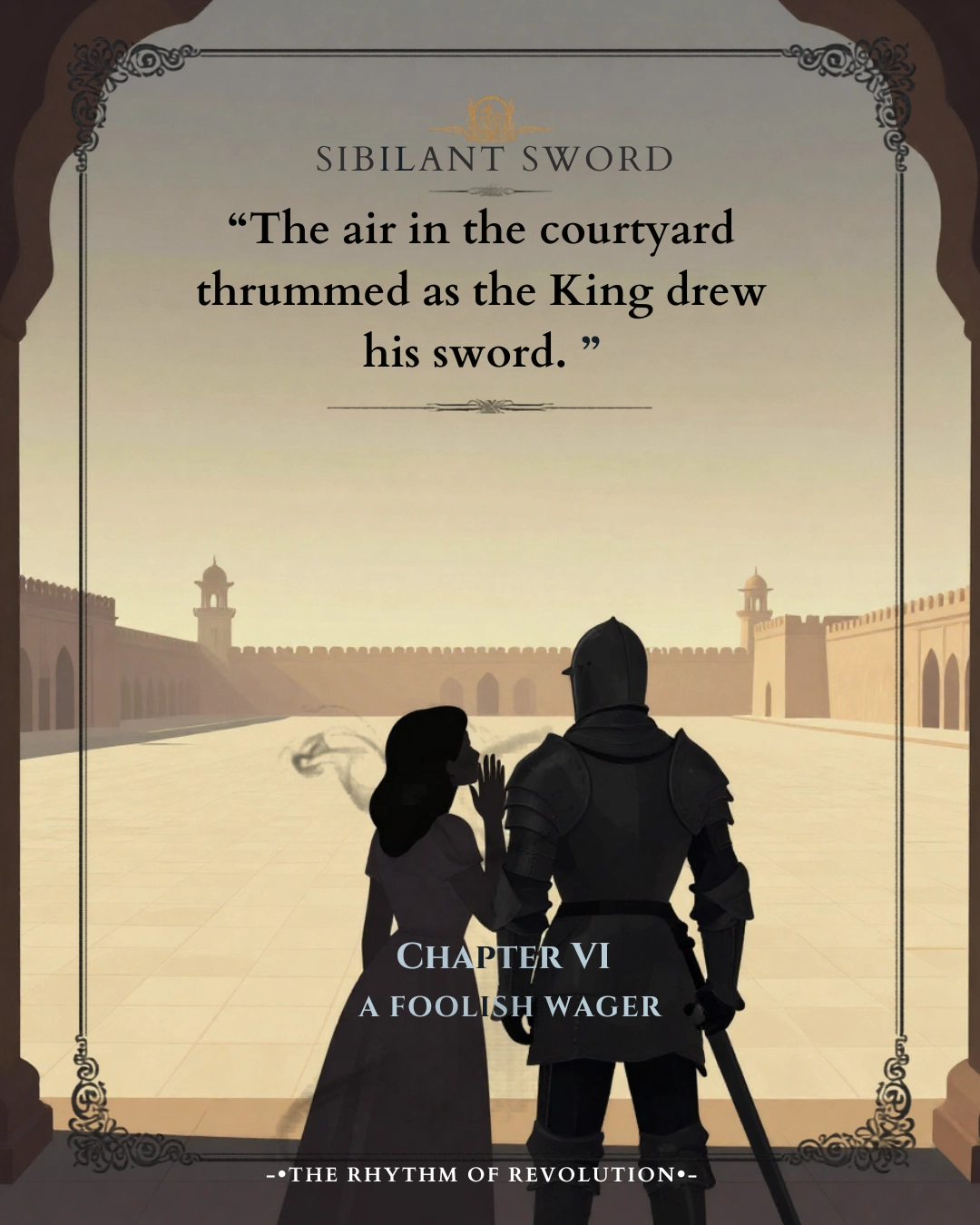
  • The Rhythm of Revolution Chapter 6

    The Rhythm of Revolution Chapter 6

    Subscribe to continue reading

    Subscribe to get access to the rest of this post and other subscriber-only content.

  • The Rhythm of Revolution Chapter 5

    The Rhythm of Revolution Chapter 5

    Subscribe to continue reading

    Subscribe to get access to the rest of this post and other subscriber-only content.

  • The Rhythm of Revolution Chapter 4

    The Rhythm of Revolution Chapter 4

    Subscribe to continue reading

    Subscribe to get access to the rest of this post and other subscriber-only content.

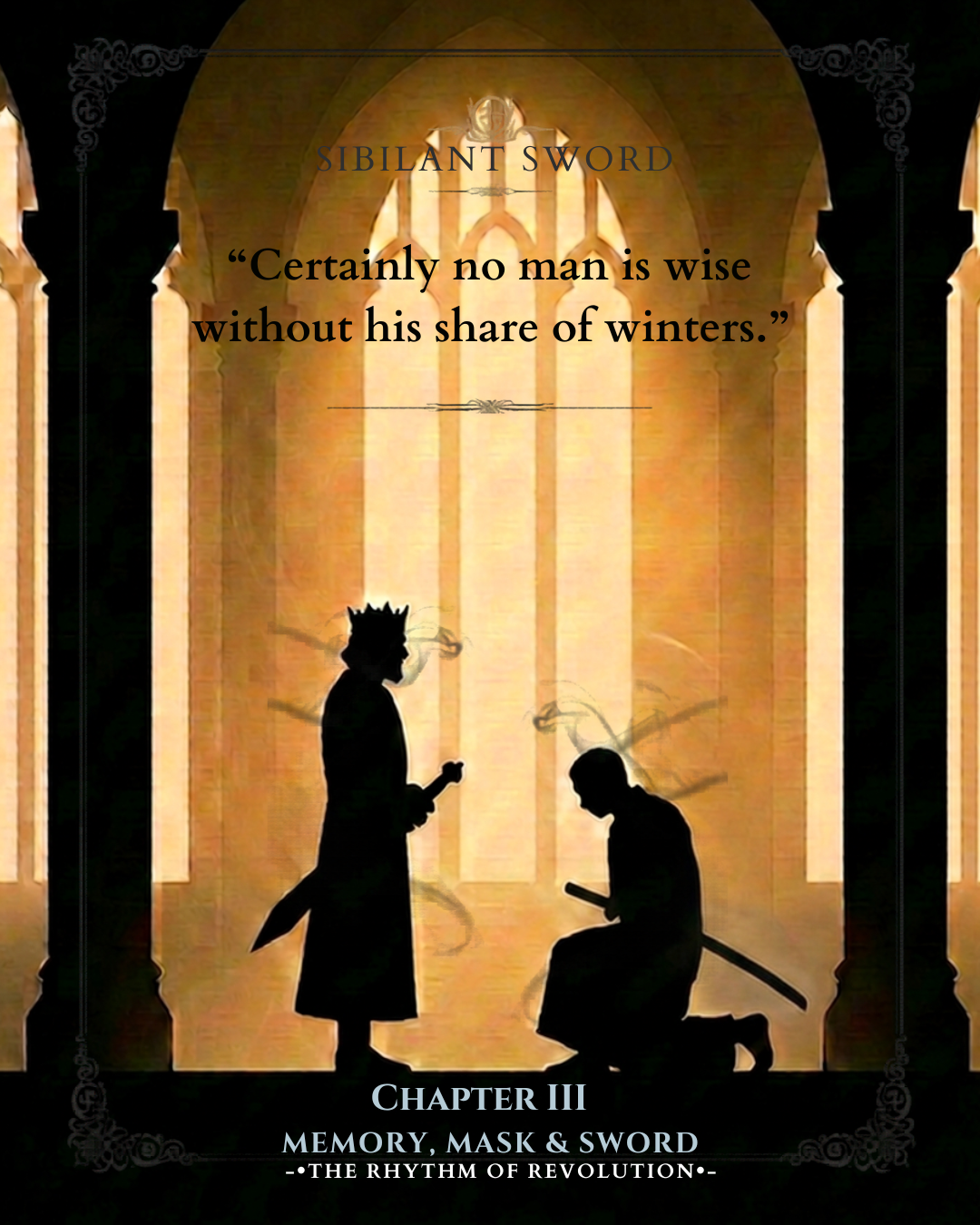
  • The Rhythm of Revolution Chapter 3

    The Rhythm of Revolution Chapter 3

    Memory, Mask, & Sword

    Mareth breathed out a deep, exasperated sigh, filled with all the care and frustration of his duties as the young Prince’s teacher. “How many times must I tell you, my very young friend? Theo you cannot be too careful in choosing your words. Every word, in its most exact meaning must be considered. The denotation is not enough. The connotations too must be given sway in your mind as you select words that will sunder and shape the world. Poetry is not purely a smattering of pretty words, nor is it so crass and complex as to require a perfect science. It is balance, delicate as an envased rose in its beauty and fragility. One cannot be too careful, can never be too careful, in choosing one’s words.”

    #

    King Theon strode through his dream-memory as if reliving it from without, his older eyes fixed on a younger self in a lesson with the Timedodger.

    #

    “Yet you pester on, Seer, on and on. How much heed do you give to your words?” young Theo said.

    “A teacher cannot be so meticulous in his words as he would wish to be, young Prince. It is the cost of the profession that one must prate in multitudes in the vain hope that foolish young men and women, yes even foolish princes who are soon to be kings, might catch a word or turn of phrase that breaks through the thick mist of their own ignorance and shines a pinhole of enlightened light into their otherwise void little minds.” As he said this, Mareth drew up his staff and gave a gentle stab into the Prince’s forehead, agitating the boy, and then continued, “If I spoke to you in a princely fashion you would learn nothing but to esteem yourself higher than you ought.”

    “I am sorry, Mareth. It seems you do have some wisdom in you.” The sly grin on the young man’s face betrayed his pretension to cunning.

    “Oh?” said the ancient man, his eyebrow raised in tell-tale expression of perfect skepticism.

    “Yes, yes. You do prate on terribly.”

    Mareth huffed, “I won’t dignify your rudeness with its typical course. Come back to our practice. Sculpt the stone.”

    A long sigh was young Theon IV’s only response, next in the line of Song Lords, Kings of Shir. On the long table rested a series of materials. On the eastern end was a bowl of water, then some softened clay mixed with mud, then a lump of talc. Next there sat a stone of granite followed by a bar of gold, a bar of iron, and an ingot of steel. Then came obsidian crystal followed by emerald, sapphire, ruby, and, finally, diamond. The boy stared down at the table, gazing at the crystals on the far end while Mareth let his expression wander as was his way. With renewed hopefulness, the king-to-be looked at the stone in front of him. He placed his hands on it as if it were fragile, closed his eyes, and exhaled.

    Yield this weak stone to my soul empowered

    Enlivened by the blood of kings and gods.

    Yield and be remade, be reborn anew

    As a great knight armoured as the Kingsguard

    Beneath his hands the stone shifted and flexed, shuttering as if life were in it. The young Prince opened his eyes to watch the expected transformation, but, as he did so, he saw the mass begin to melt away into a viscous lump.

    Mareth simply shook his head. “What mistakes did you make this time?”

    The young Prince couldn’t help the frustration from rising red to his face and setting a fatal fury in his eyes. “The words. What was wrong with the words? Surely that is all… just words. This is hopeless.” The young man tried to leave but felt his limbs seized.

    “Not just yet, Theo.” Mareth’s voice was stern. “Before you can leave you must know what you have accomplished and what you have yet to accomplish. Since you are in such a foul mood, I suppose I will lay down my prating and speak plainly. Your words were almost perfect, save one – reborn. You are working with stone that has never felt the breath of life. It cannot experience a rebirth before it first experiences a birth. Furthermore, you did not maintain the image. What are the three elements of the Spellverse?”

    The boy spoke the words as if they had no meaning. “The verse, the image, and the soul.”

    “Good, and what are the elements of the second: the image?”

    Biting his lip, the boy turned his head, his body still heavy under the spell of Mareth’s professorial will. “The image is held in the mind. It is a picture of what the poet wants the world to be. It is the intention and invention that the words of the verse are meant to describe. A firmer image can overcome careless words in the verse, but the greatest power comes when the two are in harmony.”

    “Marvelous, Theo. You have been paying attention. Here I thought we’d been going on in vain. Your temper and rudeness do you no credit. You have the gift of one out of every one-hundred thousand in this world, and in more abundance than any other currently living, save your father. You cannot afford to squander it.”

    “Can I go now? Blademaster Zimossa is meant to train me more on the sword today.”

    “Not yet. You must expound upon the soul. Look at that puddle and tell me what you have accomplished today.”

    “Nothing, Mareth, I accomplished nothing. I couldn’t sculpt the stone. I couldn’t even give it the slightest semblance of what I wanted it to be. You keep telling me my power will be great, but my soul isn’t even unyielding enough to shape stone much less metal or gems or adamantine like my forefathers. I am either a disgrace to this power or you lie when you tell me I have it. Please let me go to the sword. There I can learn.” The boy’s face had fallen, his frustration and anger crumbling into pride-wounded grief.

    Mareth stepped forward, and with a wave of his hand the boy felt the weight slip from him. Just before he could dart away Mareth laid a bony hand on his shoulder, more lovingly than Theo thought the old man capable of. “Describe the element of the soul, Theon.” The old man put his arm around the boy and pointed at the amorphous mass on the table.

    “The soul provides the force. A soul can only affect that which it is more unyielding than, what it is firmer than. To affect diamond one’s soul must be more unyielding than diamond. To affect a stone one’s soul must be…” a dawn of recognition rose in his eyes.

    “There it is, Theo. Go on.” Mareth said.

    “The soul! It melted the stone. The soul!” The boy said pointing and looking back at Mareth with unabashed joy, “My soul!” The boy stood tall and beamed as he finished. “Is stronger than stone.”

    “Indeed it is, young Prince. Do not be discouraged. You’ve greater things in you than you realize, as do most. Now, off to Zimossa with you. Be back here tomorrow at noon to continue your training.”

    As the boy sauntered away with the pep of newborn confidence, Mareth shook his head, pride smiling through perpetual sadness.

    #

    The King awoke, the dream still vivid, his memories of youth sharp as broken glass cutting against Mareth’s more recent chidings. Another lecture, another lesson. When will they be done?

    Theon IV lay abed, his childhood memory a counterpoint to his encounter with the supernatural vision of devouring darkness in the throne room. Fever had taken his otherwise powerful frame and reduced his normal vigor to naught. Neither food nor drink enticed him in the least. He lay for nearly two days in that stupor while obsessing over the vision he had seen and the warning task he was given. He had only once before felt so helpless as he did standing in the presence of darkness personified and wondered if it were the Dark Saint himself who had given so clear a prophetic glimpse.

    He did not deign to speak. There was something hateful about breaking the silence that had attended him like a lover over the past two days. He wanted calm to grow, not vanish at the crack of words spoken. Beseech her in silence. Mareth’s words drilled into the King’s mind, and he began to heed them even as the toil of sickness wracked his body. The words of the poem matter. He learned that as a boy. So, these words must be important. Elusive to men. What was it of age and manliness that drove away wisdom and her power? By child may be sought. The innocent graces of a child so pure and without the bitter poison of pretension or self-doubt must hold some secrets to wisdom, but the King had long lost his child-like wonder. Perhaps he never had it, the memories of his own training revealed long-hidden scars. Now, he had a vast empire to rule and could not do so with the naivety of a boy. He must be cunning, often cruel, sometimes merciful, but never naïve. Ev’ry suffering brings you closer to her. Children do not suffer over much, so where is the balance then that illuminates the path to Wisdom? Balance, Balance, Balance, Balance. The word began to drum his brain, a strange, methodic union of thought, but he still did not comprehend. All he knew was that as the silence lengthened, his thoughts grew more lucid. He longed to never leave its embrace.

    BANG! BANG! came a cacophonous knock at his chamber door made ever louder by the two days he had spent in seclusion of quiet thought. “Sire, there is a messenger here to see you. He claims to have news of vital importance for ‘the King’s eyes only.’” The castle steward, Itaru, made his plea with a far greater volume than the King thought necessary, as if he were screaming across the full courtyard of the keep not simply speaking through a few measly fingers’ widths of mahogany. The King sat for some seconds, letting the silence spread afresh, trying to ignore the man at his door.

    The Steward hollered again, “Sire! The man is stained with blood and looks to be battle-worn!”

    The King rose from the silks and linens of his bed and strode to the door stark naked, flipped the lock and swung the door open hitting his steward in the side of his face and body and knocking him squarely on his bony rump. Blood began to flow from the steward’s nostril as he tried to compose himself. The King towered over Itaru, a weasel of a man with a hunchback and far too many warts for anyone to ever call him comely. In his impatience, the King did not realize the blow he had struck. Roughly, but not without compassion, the nude King took the steward by the shoulders and hoisted him up to his feet, looked him dead in the eyes, and said in a whisper, almost playfully, “Where is this messenger?”

    The Steward stared in shock at his naked liege lord. The King’s skin was of a deep copper tone, as were all the Kings of Shir before him, and his eyes were a striking platinum colour. His head was covered in bristles of dark red hair, cut short, almost to a shave. On his jaw was a beard of crimson, a bit wild, and of medium length. The King’s height was just above the average man, but his build was as hard-hewn stone like the statues of great heroes which lined the courtyards. Years in peace had left his skin without mark or blemish or scar, but he refused to allow himself to become complacent in his physical prowess even with the rigors of lordship.

    The Steward was so dumbstruck by his King’s inappropriate lack of garb that he failed to answer the question and gawked while the King awaited a response. After too long a time, the King hastened into his chamber, threw on a long silver robe with a lion embroidered across the back, swung a wide belt about his waist, donned his sword and stepped by the still-stunned steward towards the throne room, expecting that any messenger would surely be there. He strode through the broad corridors of his castle as the setting sun cascaded through small windows on his right. He made a quick left turn and descended the spiral staircase that led away from Shir’s Overlook where his chamber, library, and personal armoury were located, and towards the Great Hall.

    Upon entering the throne room, the King saw a plain young man standing calmly with his hands folded. The only thing that made him seem intriguing was the visible evidence that he had taken part in a battle. His hair was matted and knotted, his boots stained the deep, dark burgundy of dried blood. His hauberk and tunic were torn and life-stained. Only his sword and scabbard showed no signs of wear, betrayed no discolouration or marks that might show them to have been employed in combat. The saya was ivory, and the hilt was wrapped with fine white silk that made a diamond pattern over thin, jet-black leather. The guard was an eight-pointed star enclosed in a circle and appeared to be made of pure ivory to match the scabbard. Where the hilt and sheathe met was a thin ring of obsidian. The sword’s beauty held the King’s gaze in morbid fascination as he noted every detail. The blade in his own scabbard sang and writhed with excitement as the King approached the Swordsman. His own blade, Peacebringer, knew this sword, and emanated the excitement of the reunion of long-lost friends.

    The Swordsman did not move as the King entered the hall. Only his eyes followed as the distance between them closed slowly. His sword quivered and hummed in its sheath, an expected occurrence that bore the brotherhood of all swords forged of Adamantine. He eyed the King with a searching and perceptive eye, hoping that this message, whatever it was, would fall upon ears that would hear and a mind open to take the proper actions. When the King entered ten paces, the Swordsman kneeled.

    So this is the King of Shir. The Swordsman pondered as he rose, bidden by the King to do so.

    The Swordsman’s voice was measured as he presented a small parchment sealed with wax bearing an ornate eight-pointed star. “Sire, I have traveled far and fast to reach you with a message from the head of my order.”

    The King tore off the seal and began to read to himself, mumbling as he went.

    “From The Knight-Commander of The Order of Adamant to His Grace, Mishorer-Rex, Theon of the Ruby Soul, Fourth of His Name, Emperor of the Realms…” His voice trailed off as his eyes raced across the page.  

    The King’s voice was laced with skepticism when he looked up to speak. “Swordsman, do you know the message that you carried to me?”

    “No, Sire, I was bidden to carry it here in great haste as if my very life and the sake of the realm depended upon my swift arrival, nothing more.”

    “Are you not trusted with such knowledge, Swordsman? I find any man suspect who will not give me his name upon our first meeting.”

    “Sire, my order was placed in disrepute nearly 500 years ago, when one of your ancestors was allowed to be assassinated under our watch by…”

    The King interrupted, “Yes, yes, I know the history, of the Order of Adamant who failed to defend the King they swore to die for. I know the true history as well.” The King paused momentarily as if caught in a dreadful memory, and then continued, “It does not explain why you have not given me your name, Sir, if you are even a sir at all.” The King made a marked emphasis.

    “My liege,” the swordsman bowed lower as his tone shifted to one of utmost respect, “when I became a Knight of Adamant I cast aside my name and was only known as ‘Knight’ or ‘Swordsman’ until such time as the King himself would grant me a new name. You see, Sire, I have not given you my name, because it is yours to give. My name, my very life, belongs to you.”

    The King stood in silent reverence for a moment for this young man. “To give up a name is not a simple thing.” He mused aloud, “Nor to give one.” A long pause interposed between the two before the King responded. “This letter bids me take you into my confidence and place you on my council. Do you believe yourself worthy of such an honor?”

    “Worthy? No, Sire, but skilled enough to be so, I am sure I am.”

    “You are quite young to hold so firm a claim to wisdom aren’t you, boy?” poetry echoed in the King’s mind “certainly no man is wise without his share of winters.”

    The Swordsman recognized the beginning of a test. “Truly said, My King, but some winters bite more deeply than others.”

    “Indeed, young sir, for now I freely grant you the title of ‘sir’ after such a reply. Yet time, I hold, is the greatest of teachers.”

    “Sire, if I may, time in what condition spent? A man, of ancient years, who lived in naught but peaceful, untrying days could not hope to gain much wisdom in his pleasure.” Memories swarmed the King as the young man went on. “Days and years spent in toil, suffering, hardship, and challenge are the greater progenitors of wisdom. Is it not so?”

    The King was struck by the boy’s adherence to Mareth’s poem and continued. “Yet, strife comes unto all men, in many forms no doubt, so only time creates the difference.”

    “Truly, Sire, strife burdens all. Yet the measure of that burden, if greater, may speed the growth of wisdom just as training with a heavier blade will speed the growth of strength. Though not always skill.”

    The King pondered all that had been said, the letter, and the young man’s strange, unnerving calm that permeated all that he seemed to be. Without wanting to, he trusted the boy, and as he continued to muse a great grin spread across his face. “Well spoken, sir. I would be delighted if you would add your voice to my council. As to your name, that is a more difficult burden. Would you wait a while longer? For now, you remain the Swordsman, and you possess the gift of Shir too if I am not mistaken?” The King knew he had judged the young man’s talents rightly at the Swordsman’s clenching of a worried fist. A mishorer indeed. Intriguing.

    The King let the silence swell before continuing, “But we will address all that later. First, where is the hospitality of my hall? I will call for some servants to set a bath for you and make up a chamber. In the meantime, I will not keep you from my table, I am sure you are stricken with hunger, and while we dine you can regale me with tales of the battles you have fought to come to me.”

    The Swordsman kneeled again, grateful but filled with an eerie unrest that he could not place. He gazed down in contemplation and whispered to the marble floor, “As you wish, Sire.”

  • The Rhythm of Revolution Chapter 2

    The Rhythm of Revolution Chapter 2

    The Simple Swordsman

    A small inn sat huddled between two large willows at a crossroads along the Derekh Shir a marvel of huge stone slabs smoothed to a perfect road connecting the Twin Cities of the Buthani all the way to Irshirana.

    The Swordsman had travelled hard for days, and his vigour waned as his body rebelled against the insane pace he had set. His horse was nigh dead, and the man’s own saddle sores ached, young though he was. Six days and nights he had rode in great haste to reach the King of Shir’s court and deliver his message. He had little further to go, but he would not drive the horse to death.

    His plain appearance was neither alluring nor ugly, merely simple. He was not tall or short, only average in almost every way save for his thinness in which he could not have weighed more than ten or eleven stone. He strode towards the inn desperate for at least one full night of rest before he reached the King’s palace.

    As he opened the door, the innkeeper met him with a bright, half-toothless, smile.

    “It’s a fine morning, like, isn’t it suh, a fine ‘un to be sure! What can Old Martha do ya fer? We got food, drink, women if yer so inclined, and proper warm beds, ya know what I mean, suh?”

    “A room would be appreciated, Miss, and a good stiff drink to send me off to dreaming.” The swordsman responded.

    “Miss?” Martha screeched, “Don’t ‘miss’ me young un, I’m as old as the world, or near enough makes no difference. But yer mighty polite, it’ll be two copper foots fer the room and ya can talk to Fat Boris over der at da bar and he’ll fix ya up right fer a drink, like.”

    Without another word the Swordsman pulled a small pouch from a pocket in his robe and handed Old Martha four copper feet, smiled, bowed, and headed to the bar while Martha yelled something about him grabbing whichever room he liked.

    He wore a robe of simple, dark wool and underneath a tunic of finely embroidered blue and silver. Atop it all was a hauberk of black leather, well-fit to his slender frame. His sword hung in a curved scabbard on his right side from a thin piece of tanned leather slung over his shoulder which he shifted to sit on a stool in front of the bar.

    Fat Boris eyed the stranger with the same mild dislike he held for all his patrons. The nickname was almost comic understatement. He appeared like a wet clay lump poured haphazardly into the shape of his tight clothing which strained against his bulk. The Swordsman was too weary for revulsion. “A Nightcap please my good man.”

    “Nightcap?” The walrus snorted through a gargantuan nose, “It ain’t yet half ten in the morning, boy. You got a problem, son?”

    The Swordsman drew a silver trophe from his sleeve and placed it on the table and stared. The barkeep stood, as quickly as he was able, poured a small tin of pure black liquor for the Swordsman, pocketed the silver and then busied himself pretending to wash mugs with a filthy rag for the evening’s inevitably poor festivities.

    The Swordsman downed the Nightcap in a single gulp and swayed as the alcohol sent a tingle of warmth through his road-weary body. The burn in his throat and the sting in his eyes transitioned to a wry smile as he floated to the nearest room he could find, slammed the door behind him, tossed the lock into place and abandoned himself to the feather bed. Soon enough, he wandered the vast Dreamscape of distant plains, other worlds.


    A banging at the door to his room rode violent into his dreams. The Swordsman opened his eyes to eerie slivers of light lancing through the cracks of the rot-worn door. A multitude of men trampled the floor outside his room. Cries of alarm and pain were clear amidst the cacophony. The Swordsman drew himself up, still weary, focused himself and grabbed his sword and hung it with the curve down across his lower back. He gripped the hilt with a reverse grip in his right hand and took a fighting stance. The familiar grip sent waves of calm through muscles preparing for they knew not what. He waited, his focus strained upon every sound, every vibration, every imperfect image captured through the narrow slits of the door.

    With a massive thud something heavy hit the door on the opposite side and shrouded the room in total darkness. The wood and the hinges creaked and warped under the weight. Suddenly, a man’s enormous backside burst through the centre of the door sending splinters and shards of wood rocketing past the Swordsman’s face and neck. He slipped his head to dodge the worst of them and let the remainder bounce harmless off his leather hauberk. The door tore from its hinges with a giant man’s rear still caught in it, and the Swordsman watched as the strange melding of man and wood crashed to the ground. Light poured into the room forming a striking silhouette around a brigand who stood a full head taller than the Swordsman, wore tattered leather military armour, wielded a knotted club, and was spattered with fresh blood.

    “What’ve we here? Someone we missed. Give me yer coin and I’ll make yer death a quick ‘un fool.” The man spoke with a smile twisted across his face that turned his otherwise handsome features hideous.

    “Here is a pouch of what little valuables I have,” the swordsman said as he loosened his left hand to snatch his pouch and toss it at the brute’s feet in the doorway before resuming his stance. “Now leave, it’s your only warning.”

    A peal of laughter echoed from the man’s lips as he eyed the young man with a mix of astonished affection and deep loathing. “Ye’ve got stones, lad, but I cannae’ let ya go now ye’ve had such a good look at me. Nothing personal ye’ll understand, but only the Formless has any more need of yer company.”

    The man stepped forward and raised his club. Three paces. He took another step and wiped his mouth with his off hand and then licked his lips. Two Paces. He began to take a third step and brought both hands together on the haft of the club. Now.

    The blade was a lightning flash from the Swordsman’s sheath which struck the giant man in an upward arc from his left hip to his right shoulder cleaving straight through his leather armour and sent deep red in a great spray onto the low ceiling. The Swordsman stood serene, sword cradled in his right hand as the brigand fell to one knee and dropped his club with a dull thunk onto the wood slatted floor. Crimson streamed from the fresh wound and pooled beneath him. He touched his hands to his chest and pulled them away, looking dumbly between his hands like they were foreign objects. He looked up at the Swordsman, his eyes losing their light.


    The brute stared as a being of terrifying form materialized behind the Swordsman who ceased to move but stood as a statue bound in time. The colours around him faded into shades of grim grey. The being wore a robe of darkest black and had no flesh upon his bones. His eyes were glowing fire, and his breath sounded laboured. His scythe was pure obsidian and dripped with blood. The brigand tried to force out a scream, but his lungs were useless as the Reaper’s scythe made the final stroke, passing harmlessly through the Swordsman’s hazy body on its path, and bore the wicked murderer into the Timeless Realms, with only dread to accompany his sundered soul.


    The Swordsman watched as the surprise in the man’s eyes transformed into a pure, sickening terror. As the man slumped, the Swordsman wondered in what form the Formless came to this man who so clearly had fled from him for fear his whole life. The Swordsman stepped over the warm corpse, knelt down and placed the back of his hand just above the mouth and nose of Fat Boris. Nothing. The Swordsman closed Boris’ eyes and said, “Go, and may The Master receive you.”

    He left the battered remains of Fat Boris and walked into the main tavern area to further assess the carnage. The room was full to the brim with thieves and scoundrels. They had cudgels, maces, sickles, and other crude weapons, though a few had blades and spears of kingdom make; standard issue for the Shir soldiery. The brigands sat among the few bodies of those who had tried to resist and helped themselves to the mead behind the bar as they laughed and counted the spoils of their assault. They’d left none alive. The sounds of screams and blows had died away with the last of their victims and transformed into profane revelry. None noticed the Swordsman until he reached the door to try to exit. One yelled a curse at him and they all sprang up, weapons in one hand and pints in the other with murder burning in their eyes.

    “No one else need die, friends.” His voice was the eye of a storm. The boorish brutes mistook his confidence for cowardice. Slowly they advanced and the Swordsman sheathed his blade, shifted it to the right side of his body, and sank low seizing the hilt with his left hand. The whole room stood still until one man shouted, “He’s just a brat! A rat even. And that’s a fine sword he’s got there.”

    They moved forward as one, though cautious like circling wolves. Bloodthirst rose in their hearts. Six paces. Weapons of all sorts were brandished. Five paces. Men laughed and sneered at the Swordsman and bumped each other as they surged forward. Four paces. “Gut him lads!” roared one particularly foul man as they took another step forward with wicked intent. Now.

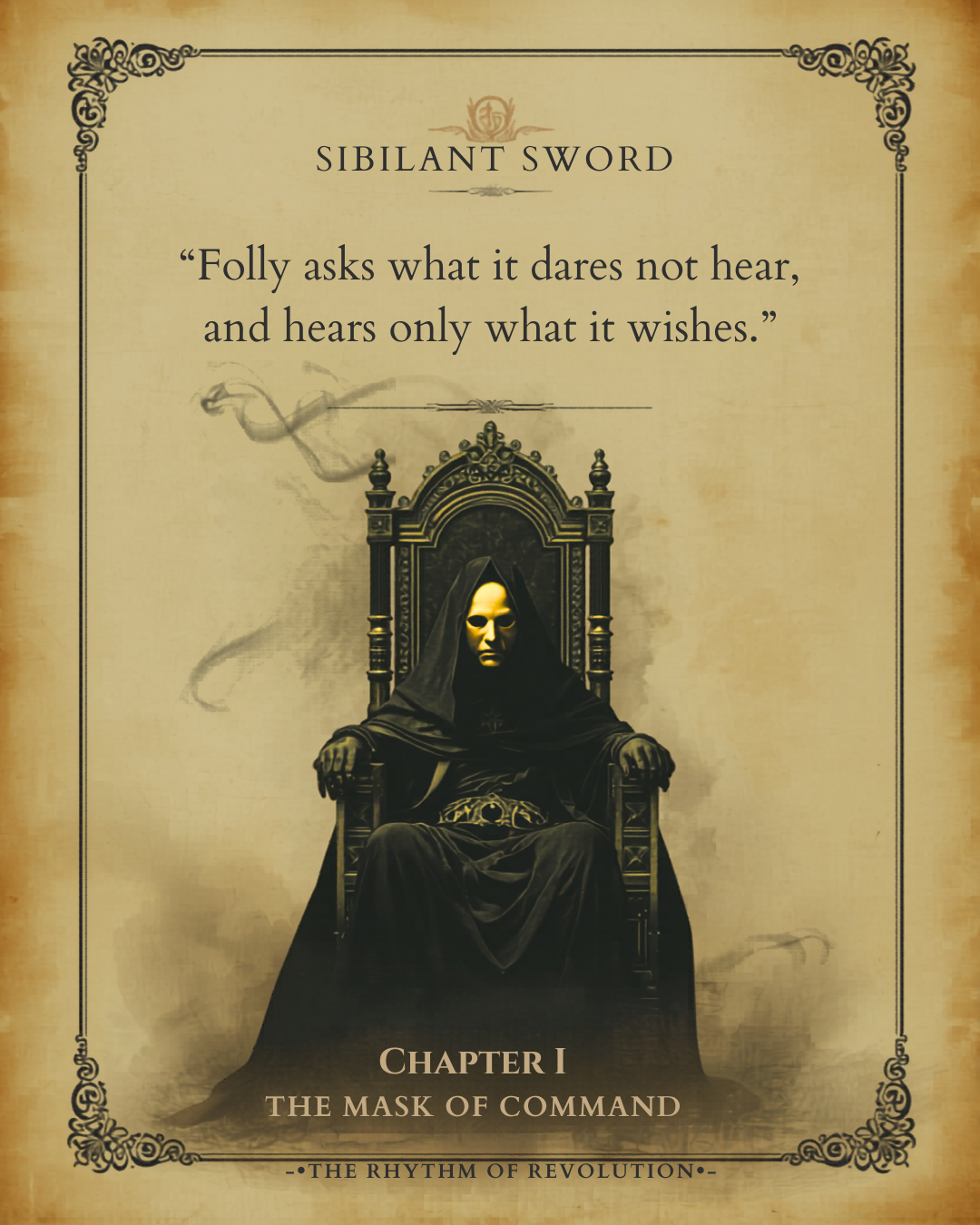
  • The Rhythm of Revolution Chapter 1

    The Rhythm of Revolution Chapter 1

    The Mask of Command

    The king slouched on his gilded throne eyeing the room with the wary enthusiasm of a fully-fed hawk. His eyes shone through the sockets in his carved golden Masekha. The great doors to the hall opened and a hush fell over the crowd as a weary wreckage of an old man came forward. Mareth’s skin sagged as if trying to escape the muscle which had long-since atrophied atop brittle bones.

    The king’s gilded mask bore a steady expression at total repose. A single inset ruby hung in the forehead of the mask at the base of the crown.

    The old man padded in on soft leather soles, the flow of his deep purple robe a train behind him. People moved around him like little human waves from the keel of an ancient boat. His simple staff resounded off the stone floor with each step.

    The king shifted in his seat, as he fiddled with the lion’s-head pommel of his sword. Darting eyes shifted between the old man and the king as the stifling heat of the day weighed like a living thing upon the room.

    Each strike of Mareth’s staff resounded across the floor made of marble which bore a series of ancient flowing glyphs in black etching upon it. The echoes carried forward riding up the inlays of ivory with the same arcane sigils which adorned the gold of the throne. Two more lions were formed into the seat itself and sat on either side with their heads as armrests for the King.

    A low hum filled the hall as men and women began to whisper at the old man’s passing. Attendants and councilmen either stood in clumps or sat on the benches which lined the edges of the Great Hall. Some fifty advisors and the four councilors of the realms had gathered in session with the King at the behest of the Old Man Mareth who finally reached the foot of the throne and slammed his staff once into the granite at his feet and silence erupted over the room. Then he spoke in a guttural rasp,

    Wisdom is hidden, must be discovered.
    She cannot be taught, only uncovered.
    As mistress she reigns o’er all and o’er naught,
    elusive to men, by child may be sought.

    Beseech her in silence or all in vain.
    From pleasure she flees, while dining with pain.
    Ev’ry hardship bears you closer to her.
    For the darkness of men, she holds the cure.

    Mareth finished, and the King replied, wearied with every word, “Mareth, why do you tire me with your ceaseless riddles? How did my fathers endure such cryptic counsel…”

    “But, my Liege, you are Mishorer-Rex, King of the Shir, Speaker of Truths, Master of Verse, why should you be weary of the very power that gave you that masekha and holds your kingdom in peace? You, more than any man living, should deign to hear verse and apply to its teaching.”

    “Mareth, why can we not speak plain? Why can you not simply tell me of wisdom and of this ‘darkness of men’ which has so consumed you of late? Surely a far better explanation could come if you lay to rest the restrictions of verse. What could possibly threaten what we have accomplished?” Here the King paused, his gaze rising from the floor and out across the room full of his advisors, past them to ponder the crystal statues which lined the hall next to load-bearing pillars. Their regal splendor paid homage to times of great tumult, but also great honor. He sighed as he spun the hilt of his sword. Its scabbarded tip whispered against the stone floor.

    He continued, staring off at the statues, his questions hollow, “Does not justice stand exalted in our midst? Are not men already of sound mind to be governed with ease, or even to govern themselves in far affairs? We have not been given over to barbarism, chaos and savagery for more than an age, why should we fear or fret? The Shir made and remade the world. The Festival of Ages comes, another millennium passed, this one an Age of Song, of the Shir. Should we not expect a steady growth and progress in mankind? Men are, after all, basically moral and upright creatures, are they not?”

    “You pepper me with questions to which you have already devised answers, Your Highness. Folly asks what it dares not hear and hears only what it wishes. I do have a task for your court, Sire…”

    “Task?” The King raised an eyebrow and ceased spinning his sword. “I am King and do not take tasks from lessers in my court, nor suffer my musings to be called folly by any man. Not even my former teacher. You forget your place.”

    “Sire,” Mareth began but was stopped by a raising of the King’s hand.

    “Your counsel is noted, but ignored, Timedodger. I don’t need riddles and games. No quests or tasks.” A deep sigh escaped the King, “The days of battle are long gone. The time for delighting ourselves with talk of knightly deeds and vain hopes for glory in hard times are past, faded into a waste of peaceful years. I doubt I even need this blade any longer.”

    The King stood. His silver embroidered robe hung just above his knees, the dark leather of his greaves revealed simple, protective functionality. His chest plate of dark steel shone beneath the robe. He pulled his blade from its sheath and raised it skyward, twisting it in his hand as he inspected the folds and craftsmanship. The warm affection from its core was tangible, a wave of fellow-feeling which had bonded them for years, ever since he had completed the keening as a young man. “That such a blade should be caged to a scabbard.” He mused aloud.

    His eyes were drawn into the labyrinth path of its temper patterns, the layers of Adamantine folded in and through and between one another.

    When the King tore his gaze from the sword and looked up, he found the room empty of all men. Mareth, the counselors, every advisor or friend vanished from his sight, and only the torches hung upon each pillar while a deepening silence remained to keep him company. The King gawked, straining to see what had just been present a moment ago. His restlessness was stolen by shock as he stood before the throne and clenched his fists against his fear. Shadows grew out of the runes on the marble floor and crept towards the torches in steady strides. The flickering torchlight shifted with sinister intent as long black tendrils swayed and stretched over every wall. The lights waned with every passing moment as shadow waged war on what little glow remained. In a matter of seconds, the King was plunged into pitch; an abyss of unearthly night. For the second time in his life he felt the fangs of fear pierce his throat, their poison paralyzing his muscles. Then came a whisper in the dark in an accent foreign to the living,

    You seek a man living long in a tomb
    humbled by sorrow and shackled by doom

    He is not of this world, nor of the next.
    No man could slay him or lay him to rest.

    In silence, of betrayal he does sing,
    and tortures himself with thoughts of his King.

    He tells hard tales of man’s true desire,
    the blade he holds can quench the coming fire.


    “Sire?” the pause lengthened like the shadows in a growing dusk until the steward placed his hand gently on the King’s trembling shoulder. “Sire, are you well?”

    The King’s eyes were dark, pools of black that betrayed no sense of sight. Slowly, the black gave way to the natural platinum of his eyes and he turned slowly to gaze at his steward. The room was full of his counselors, advisors, and friends. A nervous servant filed into the room with a goblet of wine for the King while Mareth trudged toward the door preparing to leave. The King stood with cold sweat dripping off his brow– horror etched upon his face.

    “Keep your sword, My King.” Mareth breathed as he paused before the lofty doorway, “By Eternity, you’ll need it.” The King tried to reply but the words perished in his throat. Silence hung like millstones upon the room until the great door slammed shut behind Mareth, and the King’s breath returned.

  • The Return of the Sibilant Sword

    Dear Friend,

    It’s been a rather long hiatus for the Sibilant Sword, especially on the fiction side. I have been publishing musings on theology with some consistency over on my Substack, but the last year during my Masters has left me less time for specific fiction work (except a full edit on the first Siegyrd novel and the draft of a new play, but those are stories for another time).

    As you will see, the website has been rebuilt. The previous version(s) were running painfully slow and my inability to properly track my multiple subscriber lists meant some people got notified and some didn’t when new posts dropped (or they received quite random stories and notifications as the second site was being developed. Apologies for that.) I hope you’ll like the streamlined updates in advance of the next serial I will be posting, The Rhythm of Revolution. Look out for the first chapters in the coming weeks as I finish up my Masters and head back to the states for the summer.

    If you are receiving this and have forgotten what the Sibilant Sword even is, and do not want to be bothered with epic fiction interleaved with questions of faith feel free to unsubscribe. If you have stuck with me thus far, you’ll be happy to hear more stories are coming, and they are coming here which is more conducive to story than Substack was.

    I am sorry for my absence, and grateful for your presence. Welcome back!

    All the Very Best,

    D.M. Jorgenson

  • Of Loving Locally: Or Insurgent Ecclesiology

    The single, clearest indicator of one’s inclusion in Christ’s body, the way by which we are known as true believers, is not institutional affiliation or doctrinal purity – it is our love for our fellow brothers and sisters.

    “By this everyone will know that you are my disciples, if you love one another.” John 13:35

    “Woe to you, teachers of the law and Pharisees, you hypocrites! You are like whitewashed tombs, which look beautiful on the outside but on the inside are full of the bones of the dead and everything unclean.” Matthew 23:27

    What Love Isn’t

    Before we can discuss what this “love” means contextually and ecclesiologically we must first observe what it does not mean. Love here does not mean, as our society has truncated love, a kind of radical acceptance. Love does not merely accept – it seeks the positive and persistent good for the other often at the expense of the self. Love applies a wisdom of action, passive when it should be and active when it should be. Christ is the primary and full picture of love, the one who laid down His life for His bride and took it up again for her. He also continues to intercede on her behalf and to empower her to His works and glory. Everything Christ did and does, He did for the good of His people and for His glory. There was no exchange or offer we could have made, and we add nothing to Him. Love is like that. It allows for nothing at all to seek to harm or destroy its beloved. “It always protects, always trusts, always hopes, always perseveres.” (1 Corinthians 13:7)

    This text also does not say that His disciples will be known by their love for those outside the faith, or some distant stranger, or even an unbelieving neighbor. It says you will be known “if you love one another.” There is a primacy of affection that must be maintained and cultivated for the people of God. The greatest draw of the Christian life is not its buildings, its structures, its wealth, its political power – it is its deeply familial love for one another. To be Christian is to be unified by bonds deeper than mortal blood. It is to be bound by the immortal blood of Christ. To be Christian is to be of one body with Christ Himself and all His people. It is a radical organic unity of mutual aid and love and grace and glory and deep beauty that is visible not in the majesty of its architecture but in the relationships between its members.

    “Oh but does that mean I must hate or ignore my neighbor?” No, of course not, but we don’t show the church as a family worth joining when we treat those outside better than we treat those within. Would you want to be a part of a family where the father fed the neighbor kids while his own children went hungry? That’s not kindness, it’s wickedness. For as Paul tells Timothy “if anyone does not provide for his relatives, and especially for members of his household, he has denied the faith and is worse than an unbeliever.” (1 Timothy 5:8)

    The mystical union of Christ with His Bride is not to be understood, however, as a mystical union of Christ and a human institution, be it Catholic, Orthodox, Presbyterian, or any other “affiliation.” We are members of one another by Christ and His Spirit in accordance with His Word. We are members in community, absolutely, that is to say that we must be part of a local church. Yet that local church need not be affiliated with any national denomination or “sect.” Rather, it is a church and connected to Christ by its adherence to Christ through His Word – which is the Apostolic authority which ever bears witness to Him. It is telling that the central figure of Ancient Near eastern worship was typically an idol or an image, but in the case of Moses and the Tabernacle – the central figure is the tablets of the law written and kept in the Ark of the Covenant. It is not by sight but by hearing – that we truly learn to draw near to the Lord of Glory. God’s voice speaks from the emptiness between the cherubim above the mercy seat, invisibly but audibly. And the chief visual image we are to use in order to serve Christ is our fellow image-bearers the humans of His Kingdom.

    Decentralized Ecclesiology – Mission Command

    How do we know we are a part of the church though if we do not have some overarching bureaucratic structure? Without hierarchy what are we to do? Well, we may look to an odd place, the military concept of mission command, to help us here. What Christ gives His disciples in the Great Commission of Matthew 28, and by extension the whole Church (that is any who are in accordance with His Word and connected to a local body of those under tutelage of the Word), is what anyone with a military background may rightly recognize as “mission type orders” with clear commander’s Intent and guidance for the war at hand.

    Mission type orders define a mission and broad strokes of how to accomplish it, but grant to subordinate commanders immense flexibility in how they are to accomplish this. Additionally, the Lord includes what few if any modern military commanders include in their own orders – He gives His promise of perpetual presence and provision for the work at hand saying “…and behold, I am with you always, to the end of the age.” (Matthew 28:10)

    This is a great promise indeed, as The True Church has far more in common with decentralized terrorist organizational structures than with any so-called “high church” hierarchy. It has a decentralized structure, necessarily so, for it is the true light and resistance in a world owned and ruled by the devil and his minions. The “prince of the power of the air, the spirit that is now at work in the sons of disobedience,” (Eph 2:2) is very much still at work. The True Church is an insurgency, and has always been thus. Persecution pushed the earliest Christians underground within mere decades of the resurrection of Christ, forcing familial and nodal network structures of relationships still built around a central series of beliefs and familial affection.

    A certain kind of eschatology may see institutional churches as prepared to rid the world of violence and to become the prime power, but this too is part of the Enemy’s plan – for when the Christians are working in their a-structural methods, they are almost impossible to assault en-masse because they do not mass at all. When, instead, Christians begin to gather in bureaucratic structures, the enemy has a field day with infiltrations and assaults. Have we not seen this to be the case throughout history? Have we not seen leaders in every major branch of Christianity in horrible sin, popes, bishops, pastors, presbyters. We are a fallen race, but some of this we have positioned ourself for, but trying to offload our trust to institutions instead of wrestling with the Word.

    If you haven’t read Joseph Heller’s Catch-22 you need to do just that to understand one of the major methods of the adversary of your soul – create Catch-22s. Maybe you have heard the phrase, but this is the basis in the book.

    “There was only one catch and that was Catch-22, which specified that a concern for one’s safety in the face of dangers that were real and immediate was the process of a rational mind. Orr was crazy and could be grounded. All he had to do was ask; and as soon as he did, he would no longer be crazy and would have to fly more missions. Orr would be crazy to fly more missions and sane if he didn’t, but if he was sane he had to fly them. If he flew them he was crazy and didn’t have to; but if he didn’t want to he was sane and had to. Yossarian was moved very deeply by the absolute simplicity of this clause of Catch-22 and let out a respectful whistle.

    “That’s some catch, that Catch-22,” he observed.

    “It’s the best there is,” Doc Daneeka agreed.”
    ― Joseph Heller, Catch-22

    A Catch-22 is only really possible in the false structures of a bureaucracy, the Devil’s playground. But he can just as easily create a different kind of false-Catch-22, where we think all the options are bad. The early Church might have seen the freedom of what the West has now and drooled at the possibilities. They might even ask “What might we have done with such freedom?” Yet, like Abbe Faria of The Count of Monte Cristo they are likely wise enough to realize the answer: “Possibly nothing at all; the overflow of my brain would probably, in a state of freedom, have evaporated in a thousand follies…”

    And is this not true of so much of the affluent world? Have our faculties not evaporated in a thousand follies and distractions? Well distractions are excellent ways of disarming opponents on the battlefield.

    America learned just how exceptionally difficult combatting insurgency really is through the last twenty years of wars in the Middle East. Laurence of Arabia learned and taught it a century earlier, and our own Revolution was built on the concept in large part. The “battle” of Lexington and Concord is far more a use of hit and run tactics. A decentralized nodal network is extraordinarily difficult to disarm and defeat – for they need not defeat you in return. The insurgent only needs to survive, outlive you, and continue converting others to their cause. On the other hand, undermining and destroying a bureaucratic organization is much easier – in fact it normally undermines itself, as all evil is ultimately self-defeating and unsustainable.

    This is a very old problem. The ancient Israelites were supposed to have God for their king, but they cried out for a human king in order to be like the surrounding nations. We know just how disastrous such a thing was, as even the best of the kings was a wild failure. David murdered his own man and stole his wife, mis-managed his sons to devastating degree, and Solomon was led astray by his many wives. Any attempt to replace God as the king, as the head, ends in failure. Yet, God kept for Himself a remnant – always He kept a remnant, who were His true people even amid the Baal and Asherim and many other kinds of worshipful abominations. The prophets often lived far apart from the people, since they were hunted by the ruling powers (like Elijah and the threats from Jezebel), Yet, the prophets survived to preach to the people because the Lord kept them, but it was a rare day indeed for their to be a ruling power that was truly for the Lord.

    And now, we have an inverted rejection of Christ – for though our True King sits enthroned in heaven, we elevate human institutions to the highest authority instead of the Words of Christ, and indeed Christ himself. Why do we do this? In many ways, likely because it is easier than digging into His Word and being truly committed to living well in the family of the local church. It is easier to wax eloquent about organizational affiliation which requires nothing of us than to be truly devoted to the family of Christ which is directly within our reach and has needs and problems; hunger, thirst, shelter, emotional baggage, confusion, and miscommunications.

    From a military vantage, one of the primary ways of combatting de-centralized extremist groups is actually pitting them against each other, or using their own values against them. A truly beautiful desire for unity can be exploited into a consolidation of power (which often gives the appearance of unity without its substance). A desire for growth of the Christian community can be exploited into unwieldy bureaucracies when the local church grows out of the capacity of its local elders. Ideally, just like an insurgency, then the local chapter must appoint elders and split into smaller groups again, not to cease their fellowship in the truest sense, but to protect the familial love of the people within the body, drawing people together.

    A good span of control for elders requires more shepherds for more sheep, not the consolidation of more sheep under a single shepherd. This allows for all the sheep to be fed, and for the shepherd to do his duty well and faithfully. Without it, it is like expanding a sheepfold by many thousands for a single shepherd. How is he possibly to protect them all from the wolves? Now we have a real problem in that the number of men in the church is itself small, and the number of us who are qualified for eldership by the standards of Timothy and Titus is even smaller. More men need to be aspiring to the qualifications of eldership, even if they never take the specific role within their church.

    Do you yet see the Catch-22 which the Devil has crafted for the downfall of the Church? It is age old, and we ought to recognize it by now. On the one side we are tempted to overemphasize the institutions and so create a cesspool of madness, and on the other to entirely disintegrate into atomistic one-on-one relationships with God devoid of connection to a local church.

    Over-realized Eschatology and the Association with Sin

    My whole PhD pursuit was ignited by the recognition (perhaps banal but true) that we are not driven by ideas so much as loves, not intellect but affection, and what we seem to love is the ease and low cost of “membership” in an abstract, intellectualized church denomination as opposed to the great demands of actually living with and loving those who are in our local church. We seem to love being right more than listening. We love knowledge more than wisdom. We love organizations instead of people. We love the praise and honor of men more than the praise of God.

    It is, in some ways, a noble thing to wish that the world would make visible what is true and invisible in the Spiritual Kingdom of God – but we ought not try to rush the Lord. We cannot despair of doing good because we do not yet see the visible manifestations that we wish to see. I wonder to what degree it really is simply impatience that makes us wish for the outward dominance of the Kingdom of God, without realizing that it is only hearts changed at a local, yes even familial, level which will bring any lasting change anywhere else. An institutional church can (and does) drift into all kinds of problems in a way that smaller, localized churches are guarded against by their nearer bonds of love.

    When we split churches over stupid things, we separate families over stupid things. Then again, is it any wonder when we have such an embarrassing perspective of divorce and remarriage in even “Christian” circles? (But that is a topic for another time).

    When we deny our familial ties with fellow believers over foolish trifles we also neglect those whom Jesus has purchased by His precious blood. How then do I know who is a member of the Church of Christ? Is it by some vow to a national denomination? Unlikely. Is it by a list of doctrinal beliefs and ethical assumptions? Closer. Is it by the way in which we love one another? Bingo.

    So, of any talk of schism or anything else, we must consider two questions. First – who is actually our brother? Second – are we loving our brother in this approach?

    To bring this to something eminently practical, Paul says in 1 Corinthians 5:9-13

    “I wrote to you in my letter not to associate with sexually immoral people— not at all meaning the sexually immoral of this world, or the greedy and swindlers, or idolaters, since then you would need to go out of the world. But now I am writing to you not to associate with anyone who bears the name of brother if he is guilty of sexual immorality or greed, or is an idolater, reviler, drunkard, or swindler—not even to eat with such a one. For what have I to do with judging outsiders? Is it not those inside the church[b] whom you are to judge? God judges[c] those outside. ‘Purge the evil person from among you.’”

    While it may seem noble to take some kind of high road and say you will reform a fallen denomination, Paul here makes clear that we are not to even associate with anyone who bears the name “brother” if he is guilty (and unrepentant) of sexual immorality or greed, or is an idolater, reviler, drunkard, or swindler – not even to eat with such a one. Now one might argue that this is a picture of excommunication and is only exercised by elders, but Paul is not writing 1 Corinthians primarily to elders. He is writing to the whole church. He has his epistles directing elders, but this is a command for all members of the church to take part in the concept of excommunication which is two-fold and bi-directional. If an elder is in sexual immorality, claiming to be a brother, it is not only right it is necessary that they come away from him (unless and until such time of his repentance). The other elders are critical in this process as well.

    On the flip side, if there is a member within the church who is the same, it is necessary that the whole church be engaged in separating from him so that the force of his exile from the community may actually lead him to repentance (which is ever the true hope of excommunication). In either case, it is clear, that sexual immorality, as well as a whole litany of sins are in view for separating from those who call themselves brothers. This separation is not commanded for those who are of the world, for they are merely acting according to their nature, and then, as Paul says, we would have to leave the world. Yet, from people who claim Christ and yet demonstrate these sins we are to flee, we are not even to associate with them.

    I think this is really for two reasons.

    First – by continued association with “believers” in blatant, unrepentant sin we give implicit consent and legitimacy to their sin – which is the most unloving and damaging thing we could do since sin, definitionally, leads to death.

    Second – by continued association with those who clearly violate the law and purposes of God, yet claim to be among us, we give external legitimacy to their sin and so lie to the surrounding culture, defaming the name of God and the gospel of Christ.

    What does Love Actually look Like?

    I started this speaking of love, and how we ought to love one another. Here, for clarity, we ought to perhaps consider what it actually looks like to love one another, so as to make it clear over and against the cultural connotation of love as “mere acceptance.”

    There are three essential principles I think we can bin most of love under in the Christian context – Encourage, Exhort, and Rebuke.

    I have a, perhaps simplistic, but hopefully helpful way of delineating between these three modes of love.

    Encourage means to “support a brother or sister in good work they are already doing.”

    Exhort means to “challenge a brother or sister to begin a good work they ought to do.”

    Rebuke means to “correct and admonish a brother or sister to stop doing a work they ought not do.”

    If you are already deeply in prayer and study of the word, I might encourage you to “continue with all your strength, persevere, do not flag, but press forward.”

    If you do not pray at all, I will exhort you to “pray all the more, in fact pray without ceasing.” If you never read your Bible, I will exhort you to “open it and read, be transformed by it.”

    If you are reading your Bible with poor method and twisting it, or are not submitted to a local assembly, to elders as fathers and teachers, I ought to rebuke you, “It is not to be read in that manner,” and then exhort you to read it in a different way, “here is how it ought be read instead.”

    Rebukes often, but not always, are followed with exhortations in scripture. Ephesians 4:28-29 provides two such examples,

    “Let the thief no longer steal [rebuke], but rather let him labor, doing honest work with his own hands, so that he may have something to share with anyone in need [exhortation]. 29 Let no corrupting talk come out of your mouths [rebuke], but only such as is good for building up, as fits the occasion, that it may give grace to those who hear [exhortation].” (Brackets mine for clarity)

    Similarly, exhortations also often include reasons like the Ephesians passage above. The exhortation to do this or that thing is often accompanied with the why. Speak such as is good for building up so that it may give grace to those who hear. Do this, for this purpose.

    Rebukes, on the other hand, less often seem to include the explanatory element. Though rebuke almost always has to do with sin, so even where a reason is not supplied, we know from James, that all sin leads to death. What further reason do we need not to do a thing than that it is deadly? It is only a fool who resists the rebuke to take his hand back from a viper’s strike unless someone explain to him, in chemical detail, what the venom will do to his blood. It is enough to say, “STOP!” or even to grasp his hand and pull him away from the viper’s bite. All sin, yes all sin is deadlier than the deadliest of viper’s. It seeks not only to destroy your body, but your soul and the souls of those you love.

    A right understanding of these three modes of loving our brother can be extraordinarily helpful for interactions with them, and even with ourselves. When we have done well, it is sometimes difficult to continue, for we are tired or concerned, or even do not seem to see the blessing of the thing well done – we have desperate need for encouragement in this regard. How many pastors are bombarded with corrections and questions after their sermons but rarely hear a thankful word? A right loving of a brother will recognize where there is space for encouragement, even if there is a place for rebuke as well.

    Localized Ecclesiology: How to Encourage, Exhort, and Rebuke

    Distance and connection matters to this, and this is why I say that no centralized church hierarchy can really properly function in this regard, for some distant bishop cannot know you and come speak directly to you, nor you to him. It is those nearest us that we must spend our love upon, and serve in these ways. The analogy of the light of the world, which Christ uses, might be here helpful. Remember, there is no real concept of a light without fire in the ancient world – which means any reference to light is also a direct reference, in the minds of the hearers, to heat. Being a light of the world is not merely illuminatory, it is also warming. Yet while light may carry great distances, the warmth that brings life, heat when we are cold (exhortation and encouragement), and rebuke to remove deadly impurities (like the cooking of food – rebuke) requires intimate nearness. In fact, the absolute nearest requirement is for the rebuke, closest in proximity to the heat.

    Interestingly enough, we often get the application of these things inverted, however. For instance, we tend to beat around the bush with rebukes for our concern for the other’s feelings. This is rightly a desire not to wound our brother (and we ought not seek to wound our brothers), yet, just like a surgeon ought not take some wandering path to cut out a tumor, but rather the most direct route, we must be so with rebuke. Rebuke is almost always an issue with sin, and sin brings death. We do our loved ones no favors by letting the blade of truth wander on its way to the source of the problem – rather, like a wayward surgeon, we are more likely to create greater harm.

    Hence, rebuke should be simple, straightforward, and eminently clear. Do not bear false witness, do not murder, do not commit adultery, do not make images of God or of any god to worship them. The moral law is simple and direct. If we seek to wander our way to these truths we undermine God and create confusion where He has sought to create clarity. This is most potent, nearest the flame, nearest the source. You need great elders and brothers and sisters immediately near you for this life-giving rebuke.

    Encouragement and Exhortation may come by both direct and indirect means. I can encourage you with a hearty “good job” which seeks to support you by drawing up from your own reserves of strength, or I can be an encouragement by helping you literally bear the burden the Lord has given you. Exodus 17 gives the story of the Israelites battles with the Amalekites and says, starting in verse 11 through 13,

    “Whenever Moses held up his hand, Israel prevailed, and whenever he lowered his hand, Amalek prevailed. But Moses’ hands grew weary, so they took a stone and put it under him, and he sat on it, while Aaron and Hur held up his hands, one on one side, and the other on the other side. So his hands were steady until the going down of the sun. And Joshua overwhelmed Amalek and his people with the sword.”

    The perseverance required of the faithful often demands the sharing of burdens between believers – this is a form of encouragement – literally the giving of courage or the giving of strength. This I cannot really do from afar.

    Another picture of this encouragement is in the Angel who comes to feed and strengthen Elijah after the events with the priests of Baal on Mount Carmel. Another, in our own failures, is the way which Jesus encourages Peter after his denials, giving Peter the opportunity to reassert his love and devotion to Christ face to face. Christ also heals many, which also might be a way of thinking about encouragement in a more literal sense.

    Often an encouragement is the follow-on to an exhortation or the preamble to it. In Elijah’s case, the literal giving of food for strength is the preamble to the movement to come – it is the gathering of strength for a work that is yet to be done. This is relatively rare in Scripture, I think because it eschews faith to some degree. More common is the exhortation preceding the encouragement or empowerment.

    Genesis 12 begins, “Now the Lord said to Abram, ‘Go from your country and your kindred and your father’s house to the land that I will show you.’”

    Abram is 75 years old when this occurs, and while he is wealthy by worldly standards, that, in some ways, is more a hindrance than a benefit at a time when wealth meant many flocks to feed, not mere digits on a computer screen. Yet the Lord does not say, “here is all the strength you will need, and a direct, turn-by-turn route.” Rather, the Lord tells Abram to go and promises to show him the land. Trusting God is living on His promises, so we often see this as the case in exhortation. The call to action precedes the empowerment or clarity to achieve the desired end.

    Yet all of these things require the presence of the one doing the encouragement, exhortation, or rebuke. This we lose in our attempts to distance ourselves from the localized church. So how present are you to love your brothers and sisters and to be loved by them?