Blog

  • A Comic Reminder of Coram Deo

    A Comic Reminder of Coram Deo

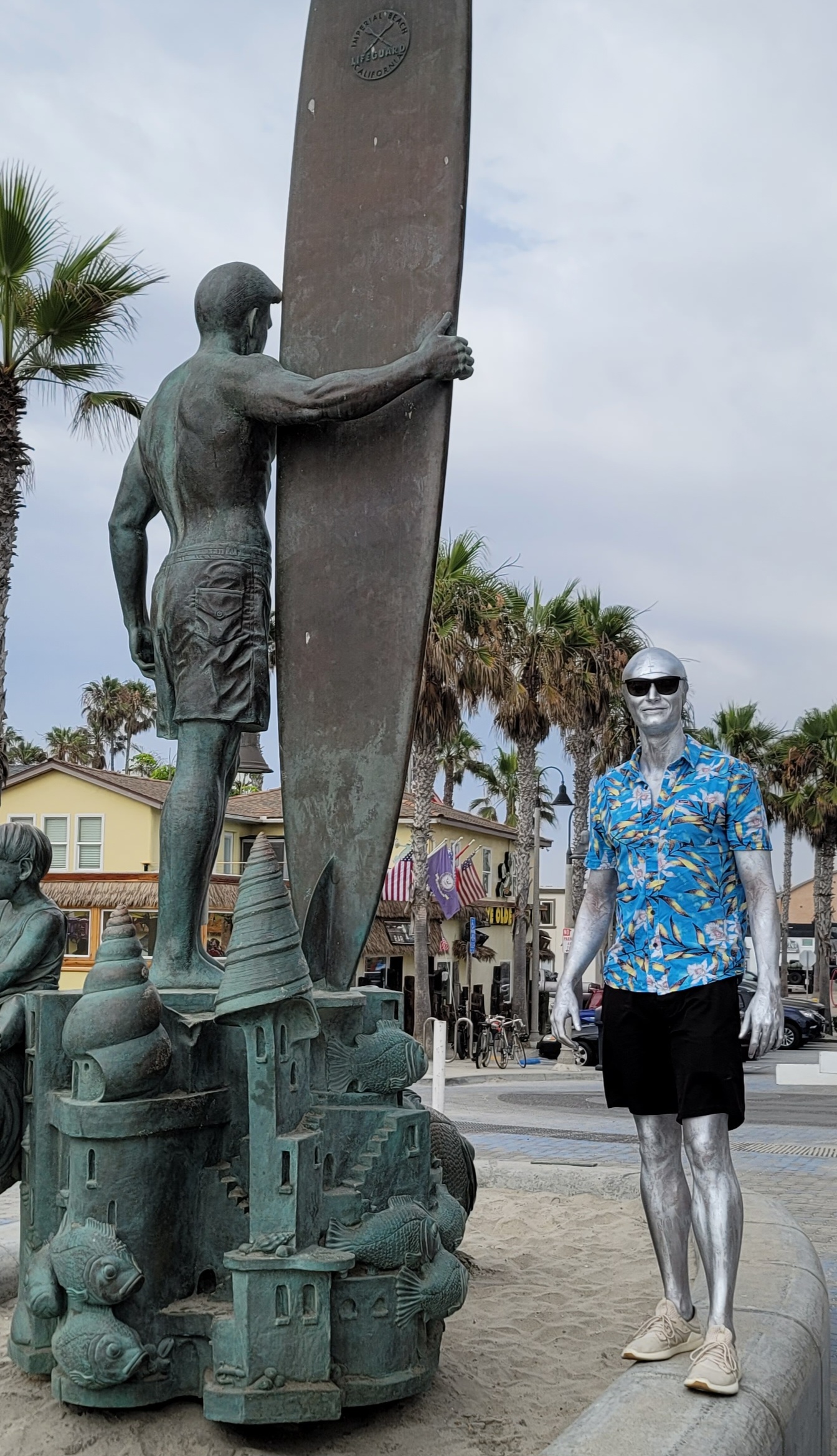
    When you paint yourself head to toe in shiny silver metallic paint, put a swim cap on your head, some shades, board shorts, and a Hawaiian shirt, people tend to stare. While this isn’t technically about surfing, it is about being a surfer. I had the opportunity to attend San Diego Comic Con this weekend with my family, and I chose to dress as the long-forgotten and underappreciated cosmic-powered Silver Surfer. I carried no prop but a beach towel and often joked about how I had been on vacation since the last Silver Surfer movie from 2007, but I committed to the bit.

                   The bright silver paint I used to create the effect took almost two hours to apply (and I will have flecks of silver on me probably the rest of my life). It was an ordeal of minor to moderate proportions, but the reactions I received throughout Comic Con were priceless. People recognized me, and they wanted pictures with me. It was a very interesting experience, to be almost famous, at least within the small sphere of that event. It was also a bit disorienting, as a more general introvert, to be immediately recognized and seen. It can be very unsettling to realize that there is no way to hide in such a situation. Additionally, anything and everything I did was likely to be interpreted in light of my costume.

                   The experience was energizing, but it made me ponder a new question. What if everyone around you could instantly recognize that you were a Christian? What if there were no hiding it? What if being a Christian meant a corona of glory sent from the distant eternal future into our present to prove that you were chosen of the King? Pick whatever marker you like, but the idea that you might be laid bare before the whole world, outted as a Christian instantly and being unable to hide might raise strange concerns in you. If it does, beware. While there is no literal golden glow, or paint, or mark that demonstrates visibly our election into the kingdom of God, there are marks that are expected. If we begin to think instead about the Lord God as our audience, rather than imperfect man, it becomes even more unsettling.

                   Coram Deo, an oft used phrase of John Calvin which means “before the face of God” contains the idea that everything we do ought to be done in light of the absolute reality that we do so right in front of God’s face. We act, live, move, breathe, converse, exist in the direct and probing gaze of our holy and righteous creator. There is no getting around that. There is no escaping or hiding from such a gaze as His. Now, we might think that a terrifying thing, and in a sense we are correct. Yet, for those of us called according to His Grace, there should be joy in knowing that our father is watching, and a springing desire to please Him in all that we do. It is the longing of a child dancing for their daddy’s delight.

                   In both directions, dressing as the Silver Surfer made me consider things in a slightly different manner. How much of my life is oriented toward a fear of man, what they might think or do if they knew who I really was? How much of me am I hiding on a day-to-day from those around me, loved and unloved, known and unknown? More than that, how much of my life is lived in true, considered awareness that the Lord Almighty is watching, is present, is proud of the work His Son Jesus has completed and is completing? How much am I growing in the light of the Lord, in the beautiful knowledge that I do so Coram Deo? How about you?

  • The Widow’s Warning

    Luke 20:45 – 21:5-9

    In the past two weeks, I have listened to two different sermons on Luke 21 and the so-called Widow’s might (or mite depending on who you are). A conversation from many years ago with my sister keeps needling my conscience about this passage, though, and I would like to address what I think may be an alternate approach to the text based on the context. 

                   Most sermons around this passage go something like this: The scribes and pharisees and rich give out of their abundance, but look how amazing it is that this woman gives out of her poverty. This is a reasonable interpretation in many ways, but there is something strange about it. One pastor I listened to said that Jesus commended her, but let’s look at what Jesus says. Jesus says “Truly, I tell you, this poor widow has put in more than all of them. For they all contribute out of their abundance, but she out of her poverty put in all she had to live on.”

                   First: He says that she put in more than all of them. This is not necessarily a commendation for her as much as it is a condemnation of the others, but we will address that in a moment.

                   Second: He clarifies saying that they gave out of their abundance, but she gave out of her poverty. He makes clear that he is not talking about the absolute value of the coinage added, but rather the comparative value of what she gave versus what they gave.

                   Finally: He further explains that she put in all she had to live on.

                   I am going to take this in the reverse order to try to explain what might be the case.

                   To put in all she had to live on could mean, on the surface, one of two, very different, things (with a possible third we will address as well).

                   One: She had faith that God would provide for her needs, and therefore it is an act of brilliant faith. This is the typical interpretation of the passage.

                   Two: She actually had no faith left and was giving away all that she had to live on to essentially give up and go die.

                   There is a third option. Rarely are we motivated as humans by a single thing at a single time. We are fragmented beings. It is possible that her giving up all she had to live on was both an act of faith and an act of giving up. The logic would go something like this – if the Lord is good and real and gracious, He will provide, but if He does not, I will go to the dust. It might have been a kind of final test of God’s goodness. It is disturbing perhaps how often despair can look like faith – after all. The widow here might be at the end of her rope, to use a colloquial expression. We might call this a kind of fatalist resignation.

                   So, what does the passage as a whole support for interpretation? Jesus seems to be using her action to shame the people present, the rich and the scribes (at least in part). If that is the case, then this doesn’t really help us choose between interpretations, because whether the woman is being commended for faith or giving up in resignation, both equally shame the wealthy. One shames them by demonstrating greater faith and generosity in the widow, and the other shames them by showing how their so-called generosity is not efficacious to help the very widows and poor the money is supposed to go to. One shames by degrees, the other by a display of impotence. The phrase about the comparative value doesn’t help all that much in choosing between interpretations either. It could indicate to the scribes and wealthy either their lack of generosity or their impotence (or both). Where have we arrived then? This verse alone doesn’t give us enough to discern whether the comment about the woman is a commendation or merely a comment (or even a condemnation). That happens often in Scripture, and praise be to God that He gives us more than just discrete verses from which to understand His Word!

                   What other questions can we ask that might help? Well – who is Jesus audience? For the answer to this we need to go back to the end of chapter 19 and into 20. Jesus is in the temple. By the time we get the discussion of the widow’s offering, we have in verse 45 of chapter 20 that Jesus is speaking “in the hearing of all the people… to his disciples.” This creates a complex relationship in the audience. He is speaking directly to His disciples, but in the intentional hearing of all those gathered in the temple. If we remember, the temple is likely to have been packed due to the upcoming Passover feast, so the broader audience is people of every walk and perspective and place around the kingdom, from the youngest untrained girl, to the elderly chief priests and scribes.

                   Still, we cannot forget that Christ’s primary audience is His disciples. His secondary audience includes everyone around, including the scribes, wealthy, and pharisees. Does this help us clarify the question from before? What does Jesus want His disciples to learn from the example of the widow? To give all they have to shame the people around them? For this, we need to keep reading from verse 46 in chapter 20. “Beware of the scribes, who like to walk around in long robes, and love greetings in the marketplaces and the best seats in the synagogues and the places of honor at feasts, who devour widows’ houses and for a pretense make long prayers. They will receive the greater condemnation.” (46-47 emphasis mine).

                   Jesus tells his disciples explicitly to beware of the scribes who do all these hypocritical things and devour widows’ houses. How do they devour widows’ houses? Doesn’t that seem an odd inclusion in this moment? It seems very specific. But then, our Lord, who is sovereign over all, looks up and is immediately provided the object lesson of the widow having been devoured – a poor widow who puts in all she had to live on.

                   One could almost see it like this. Jesus condemns these scribes, and then immediately sees an example of the type of behavior he has just been describing, from both sides. He sees the wealthy putting in their gifts alongside a widow who is turning everything she has left over to the Lord – whether in faith or resigned despair we are not told. A possible problem with the widow’s might interpretation is not that it is impossible, but rather that it is not explicit. Remember, Jesus is trying to warn His disciples against certain behaviors and underlying beliefs, so here we have a poignant object lesson of both the act and the consequence of the scribes’ pretensions. Wealthy people place gifts in an offering for the poor while standing next to a poor widow who herself requires utmost help. Do we see the duality of this picture?

                   The offering, meant for the poor, was clearly not being used to take care of the poor as the Jewish Law demanded (or at the very least had not reached this particular widow), so what was it being used for? One possibility is implied in verse 5 of chapter 21. “And while some were speaking of the temple, how it was adorned with noble stones and offerings, he said, ‘As for these things that you see, the days will come when there will not be left here one stone upon another that will not be thrown down’” (Luke 21:5) It is possible that the offerings were being used for the adornment of the temple rather than the aid of the poor.

                   It is sometimes too easy for us to look at chapter and section headings in our Bibles and forget that they did not exist in the original text. This is one story, and the events are not discrete but connected. It is not an accident that immediately after seeing the widow put in her coins, which follows immediately on the warning against the scribes, that the Lord’s next words are a prophecy of the destruction of the temple – and of the whole temple system which has twisted God’s intent and devoured widows for the sake of outward show. The temple itself here has become an object lesson of the scribes’ pretensions and hypocrisy, as its adorning is in stark contrast to the poverty of the widow. The widow herself is the chiastic center of this story, pulling together the outward actions of the scribes, and the outward adornment of the temple and showing them both to be the hypocritical whitewashing of tombs – outward beauty which obfuscates inward death.  

                   What then do we say about the widow herself? Was it might that put those last two coppers, all she had to live on, in the offering? I can only say I don’t know. The Bible does not give us her intent, or give us a peak behind the curtains of her mind and heart, but what it does do is contrast her action with the fake actions of others, the intent of the temple, and the eventual promise of destruction. Whether or not the widow’s act was a mighty one of faith is, to me, a bit of a red herring. More important is Christ’s warning to His disciples, and truly to the whole Jewish nation (and to us as the Church) of the hypocrisy inherent in the systems expressed in the scribes and the ostentation of the temple, and how Christ will bring it to an end, that He may bring a new beginning. Truthfully the story was never about the widow, rather about Christ and His people.

                   The irony of the “widow’s might” interpretation is that it might create a new kind of hypocritical pretension by focusing on the woman instead of on the lesson Christ was trying to teach. It tells us to give everything we have to live on in some kind of sacrificial display, but there is pride even in that. “Look how much I gave up,” can be a trap that hyper spiritualizes practical issues of stewardship in our lives. It can elevate poverty to a moral good, when no such thing is taught, in the same way that we can denigrate wealth as a moral evil (which is also not taught – though the love of money is indeed the root of all kinds of evil). The real trap here isn’t in our moral reckoning of relative states of wealth, but in the comparison of states between people for ourselves. Christ uses the comparison to demonstrate issues of concern for His disciples – don’t be like them – outwardly good yet inwardly inconsistent, incoherent, and evil. It is a deadly snare for us to use similar comparisons, however, to rank or understand our relationship to the Lord since as debtors we are all of us without a single penny before the Lord of Glory.

                   I will break now my own rule of comparison to prove a point. Where the widow had two copper coins which could be given away temporally, we have literally nothing of value to offer unto God spiritually. If the wealthy were to look at the widow and see their shame, we should look at her and see Christ’s mercy that though we had and have absolutely nothing to offer Him, still He has saved us by His abounding grace. We should also see in her, alongside the other object lessons of Christ in this passage, a warning against all pretense that says – in giving, in poverty, in wealth, in outward show, or in inward “goodness” – we have anything at all good to offer unto the King of Heaven. Rather – “What shall we say to these things? If God is for us, who can be against us? He who did not spare his own Son but gave him up for us all, how will he not also with him graciously give us all things?” (Romans 8:31-32)

                   The widow is a warning that should point us to the eternal and magnificent might of Christ – to the praise of His glorious grace – and erase all pretension from us. The generosity of Christ beggars all our so-called generosity. The justice of Christ invalidates every notion we have of human justice. And any so-called sacrifice we might make, whether in goods, time, energy, even our very lives is as nothing compared to the perfect sacrifice of Christ upon the cross.   
  • Remember Your Hands!

    It was a beautiful new year morning on the North Shore. I got to the beach early, hoping to start this new year at sunrise with the waves. I had my longboard ready and paddled out from Pua’ena Point into the break. It was a beautiful day of smooth waves, though nothing huge. I made my way out into the waters with only a handful of other surfers around me, and started looking for the next wave.

                   I caught a few early, had some short rides, and then went back out into the lineup again. I had only been surfing a couple months at that point, so I was amped up and focused on my board above basically everything else. Still, as I kept catching waves, and things started to feel more relaxed, something unexpected happened. I remembered I had hands. That may sound like a foolish revelation, but it was a true revelation to me. I caught a line on the wave, saw the path I wanted to go, tore my eyes from the front of my board, popped-up and suddenly was aware that I had hands. Moving those hands (and the connected arms) helped me balance and turn more easily.

                   Maybe you are laughing at me right now, or shaking your head like I am the dumbest person in the world, but this was a startling realization, and instantly my ride was better. I could maneuver – not well, but infinitely better than the absolute zero maneuverability I had before that. Maybe you have never surfed, but it’s likely you have experienced a similar widening of perspective in other areas of your life. Maybe in a tense moment you suddenly realized the broader context of an argument, or you recognized a outside influence that was invisible to you before because you had been hyper focused on the problem ahead of you.

                   In stressful situations we can get tunnel-vision and exclude all other surrounding information. While this can be helpful to the particular task at hand, it can also be a huge detriment to expanding skill. The hyper focus on a single hand pattern on the guitar is to the detriment of the broader context of the neck and developing fluency with the instrument – or, in this case, my hyper focus on the nose of my board and desire to stand to the exclusion of everything else meant I could stand but little else. Without the wider context of the waves, and the whole of my body, my mind was starved for all the information it required to act and react appropriately to the movements of the water and the shifting of my weight and balance on the board. Simply put, tunnel vision made it so I could stand, but I wasn’t really surfing until my vision widened. I had to rediscover my hands.

                   As Christians don’t we often get tunnel-vision that blinds us to important surrounding concerns and stymies our growth? It could be a particularly gripping sin that you are so intent on overcoming, that you miss surrounding causes and contributing factors – and more importantly you forget that Christ has paid for all of your sin already. He has covered it entirely, and it has no power. You are free indeed.

    It might be a diligent focus on only one area of Biblical study, to the exclusion of all others. Rediscovering your hands may be expanding your study of eschatology, for instance, to a study of Christology – not just when He is coming back, but expanding to who He truly is today and forever. Your tunnel vision might even be a positive desire for something good and of the Lord, like a spouse or Godly relationship, but in such a manner that it chokes out the rest of the world around you. You see nothing else. Rediscovering your hands may be the joy of the community that God has around you today, to prepare you for the community He wants you to bless and be blessed by tomorrow.

                   Whatever the case may be for you, in Surfing and in the Christian life, there are times when you need to be really focused on one thing, and there are times when you need to expand out your perception so you can see more than you did before. When you do, you both recognize and become more through God’s grace than you were before you saw. Praise be to the One who brings sight to the blind and helps us rediscover our hands and all the grace He has already shown us that we may be empowered to further glorify Him as long as it is called today.

  • The Pure Power of Paddling

    Arch your back in a banana shape, paddle smoothly, straight forward. Hold your hands just so. Don’t rock side to side. Use your body weight. Position correctly on the board, not too far forward or back. Paddle, paddle, paddle. See the wave, turn, paddle, paddle, paddle. Catch the wave, paddle, paddle, stand. Ride for some seconds, maybe up to a minute on an epic wave, and then paddle back out.

                   On a great day I might catch fifteen waves in an hour, with an average ride of maybe fifteen to twenty seconds. That’s three to five minutes of actually riding to fifty-five or fifty-seven minutes of waiting, watching, and paddling. How often do you see an epic reel of someone waiting for a wave, watching waves, or paddling around between waves? Sure, perhaps you have seen some lesson videos on how to paddle or read waves, but the vast majority of surfing content is about the surfing itself. There’s nothing glamorous or impressive about paddling, waiting, or watching, but without it you will never catch any waves. Without this unglamorous, rote activity, the epic airs, beautiful maneuvers, and cool nose rides can never occur. Put bluntly, most of surfing is waiting, watching, and paddling.

                   After an hour, when I first started, the paddling had exhausted me well past the point of being able to lift myself up on the board to even catch a wave. As I have grown in my paddle strength, as well as wave reading skill, I can go out for two to three hours at a time. My wave count is way up because of this, but I never would have gotten there without some practice with paddling, waiting, and watching. I had to learn to love this part of the process if I was going to love riding the waves themselves.

                   You likely see where I am going with this, but most of life is waiting, watching, and paddling too. The Christian life is built around the foundations of the ordinary means of grace. I want to emphasize ordinary. God has established ordinary things for the dissemination of grace to His people, for the equipping of the saints of God. Among those ordinary means are Bible reading, listening to sermons, attending church, serving in church, engaging in fellowship, prayer, fasting, the Lord’s Supper, and the witnessing of baptisms (or baptism itself if you’ve yet to be baptized). These ordinary means are the necessary fundamentals to Christian sanctification – they are waiting, watching, and paddling. Without them, you and I will both be useless to the King when He does send a wave He wants us to get on.

                   I was sitting in one of my favorite coffee shops on island (after a beautiful morning session of surfing) – Surfer’s Coffee in Wahiawa – and overheard two men talking about their faith. They were disparaging some church, whose name I did not catch, for being too focused on the Word. One even went so far as to say that we are in the “third testament now” and are essentially supposed to be writing the next chapters of the Bible. They kept bringing up miraculous or highly spiritual events, healings, casting out demons, ecstatic activities. The one man kept talking about “power” and what was coming and the need for power. I regret I did not have the heart to engage them in their conversation, though I am convicted that I should have. What he seemed to mean by power is really just the equivalent of a kind of magical obsession – lame walk, blind see, demons flee. But what does the Word say is the power of God? “For I am not ashamed of the gospel, for it is the power of God for salvation to everyone who believes, to the Jew first and also to the Greek” (Romans 1:16) The Gospel is the power of God unto salvation. And if we are going to discuss miracles, there is no greater miracle than the regeneration of an eternally dead soul to the new creation of a Son of God.

                   What good a healthy body if the soul dies? What good to be free from demons if you are not then surrendered to the Holy Spirit – lest many demons return to take up residence (Matthew 12:43-45)? What good to see the beauty of God’s creation with the eyes but be ever blinded the beauty of His person through blindness of the Spirit? Rather than seeking temporal miracles, ought we not instead pursue the truly potent miracles of eternity – lives surrendered wholly to Christ? Of course, and the miracle of the Lord’s Gospel is that there is might which He has placed in the mundane, every day grace He has given us. He is our daily bread, our living water, the very breath in our lungs. Like all these things, we need Him daily, not in ecstatic overwhelming miraculous experience (though those waves do arise), but in the waiting, the watching, and the paddling of the ordinary means of grace. Harnessing the might of the mundane, the overt power of the ordinary, is the real key to the greatest walks of life with the Lord. Men of constant prayer, study, service and fellowship, are men who move the kingdom not by their own miraculous might, but by the grace of our glorious Father.

                   So, we may as well learn to enjoy the seemingly monotonous in knowledge that it is building toward something beautiful for the Lord. Let’s get paddling.

  • A Godly Revolution?

    Pondering American Independence

    I raised the question at a recent men’s group in my church of whether or not the American revolution was a Godly revolution. In a church full of many military members and their families, it is no surprise that this kicked off a bit of a storm of disbelief, confusion, and even anger. Thankfully, the men of my church, while heated, are Godly pursuers of the truth, so we were able to have the conversation without too much consternation after the initial shock. The premise of my question was essentially, is it ever right to seek the overthrow of a sovereign if, as the Scripture says, “…there is no authority except from God, and those that exist have been instituted by God” (Romans 13:1b)?

    Now many might argue that doesn’t seem to apply to godless governments, but context here helps us. Historically, Paul’s letter to the Romans is most likely written to them during the reign of the Emperor Nero. While ranking wickedness may not be all that productive, Nero certainly is no slouch in that department. He would have Christians burned as torches in his garden, fed to wild beasts in the coliseum, and imprisoned indefinitely. Compared to this, taxation without representation seems a bit… trivial.

    Of course, I would not expect for non-believers to consider whether or not something is godly before doing it, but for a portion of the founding fathers, and colonials, who were indeed Christians, I am curious what questions of conscience might have arisen. One of the men in my group said essentially, “well it wasn’t an overthrow attempt, we were breaking away, so it isn’t the same.” I didn’t have the wherewithal at the time to answer well, but the very next verse in Romans seems to undermine that thought. “Therefore whoever resists the authorities resists what God has appointed, and those who resist will incur judgment” (Romans 13:2). It doesn’t say attempts to overthrow, but rather “resists.” To resist the given authorities is to resist God.

    How do we defend resisting the taxes of a distant king then? I am not sure we can. I am not sure we have the Biblical basis to say that what was commanded by King George was somehow directly in contradiction to the will of God, which would put us at odds fundamentally. Certainly there was resistance, after all, in the time of the Roman Emperors when people would not bow to worship the Emperors rather than God. This is clear enough, but did we reach such a level in the American revolution? If we did, please, enlighten me. I recognize that I am oversimplifying a multi-variable problem of causes, consequences, and contributing factors to the American revolutions, but when was the last time you legitimately tried to defend the revolution with a Biblical rather than secular argument? I have yet to see it even attempted.

    I am no historian or expert on the American Revolution, so I will not venture to answer whether the revolution was Godly or not on the celebration of our independence. I will only say that the more I study the Word, the more dubious the revolution seems in my eyes. I raise the question today because it is one that we as believers, and believing men, need to fearfully consider in our modern moment. We have no shortage of ungodly laws being passed, and no shortage of opportunities to disagree with the running of the nation, but it takes God-given courage, conscience, and discernment to recognize when the lines have been crossed in truth– where what is asked or commanded of us by our society is actually in direct conflict with God’s Word. It takes further courage and wisdom to consider what then to do when those conflicts arise.

    It may seem mad for me to raise such a question today and not give an answer, but the question, and the ensuing conversation, is, for now, more important than the answer because without asking the question we may dangerously assume that what occurred was righteous (or wicked) without reassessing our assumptions. We are now in a kingdom that God did establish, so it is owed honor as an authority established by Him. Still, there is value in considering whether it was established by men of God for His purposes, or rather by wicked men who God has guided to His purposes. In truth there is likely some of both. No nation rises without His leave, nor falls without His judgment. Were we risen up to be a light on the hill or an example of His judgement? Likely both here as well. For we who serve the True King and a higher kingdom, how do we serve that Kingdom faithfully within this one in which we currently live? That is a question we desperately need answers to, and it is my prayer that this difficult question, raised on a day of remembering independence, will drive some independence of thought that will guide us to righteous action for the glory of our God.

  • Wicked Winds

    A silly idea is current that good people do not know what temptation means. This is an obvious lie. Only those who try to resist temptation know how strong it is…You find out the strength of a wind by trying to walk against it, not by lying down. A man who gives in to temptation after five minutes simply does not know what it would have been like an hour later… We never find out the strength of the evil impulse inside us until we try to fight it: and Christ, because He was the only man who never yielded to temptation, is also the only man who knows to the full what temptation means — the only complete realist.

    C.S. Lewis – Mere Christianity

    I left work a little early, put my board in the car and rode down toward Waikiki with my buddy. Traffic down to Town was a nightmare, and the forecast indicated that sand island was likely to be just as good as town anyway. It was closer so we pulled out of traffic and toward the sand island break. It’s past the coast guard base (which I didn’t even know existed) in a less than scenic portion of the Honolulu Harbor complex. High chain link fences, a few walls, some barriers, graffiti, and large shipping vessels dotted the horizon around us. Our first clue that it wasn’t going to be much fun for the day should have been that only two other people were there. They had decided to come in from shore and play hackey sack instead of continue surfing. Still, my buddy and I had the itch. We needed some waves, so we went and made it happen.

                   There are a couple entry points out into the water from there, but we entered from behind a series of jetties that created a calm section in the water. Winds were something like twenty-five or thirty knots. It wasn’t long past the jetty that we realized it wasn’t the best day. Ok that’s an understatement. It was a straight trash surf day. The water was choppy like a deep sea fishing excursion and it was almost impossible to see while paddling for the waves as bits of spray would blow into your eyes and sting your face. We also didn’t know the spot well, so we kept having to pull off waves due to poor positioning near shallow reef and a wall between us and the actual shore line.

                   After about ninety minutes of struggling, (I think my friend caught one wave, and I had a big goose egg.) we were much farther from our entry point than we thought, and there were barriers to returning to the beach any other way than where we entered. The wind whipped the surface of the water in a cross pattern that almost churned the surface of the water. It was an exhausting, blinding, brutal paddle back to shore as the surface current from the strong winds fought us every single stroke. If we stopped or paused to rest for too long, we would be pulled back outward. It was a water treadmill that persistently sprayed your face and tried to flip you over. Eventually, blessedly, we made it back.

                   There are plenty of lessons we could draw from this misadventure. Know the conditions. Think before you go out. Don’t be too greedy for what you want. Still the quote from C.S. Lewis that I placed at the beginning of this post seems most apt. The wind was at our back as we headed toward the break, so we hardly noticed it except that it ruined our waves (and fun), but once we had to go against it the story was wholly changed. Often when we are traveling in the wrong direction in life, it feels very easy indeed. When temptation is sweeping us along, we can claim we know what it’s like – its strength and power, but we don’t know the first thing about just how far it will take us, and how difficult it will be to get back until we turn and resist.

                   I have often puzzled over the idea that Christ was “tempted in every way, yet without sin.” I sometimes am guilty of thinking somehow that Christ dealt with less temptation, which made his road easier. After all, He doesn’t have a sin nature. That is foolish, obviously, but Lewis’ reformulation, as well as my own experience fighting the winds paddling back to shore that day, remind me in fractions just how incredible our Lord is to have never given in to temptation – not once, in His entire life. He was and is the perfect man. The God-man to be sure, but touching His humanity He is the new Adam – the father of the new race of human beings who God has called to be His children. He is a priest forever not based on lineage or special rites, but on the basis of an “indestructible life” (Hebrews 7:16).

                   Two quick lessons here. First: In your own struggles against temptations, whether that be for a particular sin, being swept up in the patterns of the world, ideologies, or the like, remember Him who endured such things on your behalf and submit to His strength which bore every possible temptation and to a far greater degree than we can imagine. Second: Don’t chase the wrong waves on the wrong day – in other words, be careful where you are directing your desires. A little discernment goes a long way in dealing with temptation, largely by avoiding the occasion for it. For all of us who have fallen at various times, we understand just how painful it can be to paddle back to where we are supposed to be. After two hours, much exhaustion, and who knows how many liters of swallowed sea water, I caught exactly zero waves and had only muscle soreness and immense thirst to boast in. If you can’t draw the parallels with that to your own struggles against sin, then please contact me to teach me your ways.

  • Scared Silly

    I recently returned from almost a month’s worth of traveling around the globe – a little Asia, some US Midwest, some island hopping, and a bit of the East Coast. Getting back to Oahu, one of the very first things I did was throw my 8-foot foamie in my car and head to the waves. There was nothing great, no giant clean waves (and it was pretty choppy), but it just felt good to be back in the water. It was late afternoon, hot, and beautiful. I intended to stretch a lot before heading out, especially after how many hours I had spent sitting in planes, but the ocean pulled me in inexorably. My leash was on, I had timed my entry so a return wave would carry me out the back, and I was off.

                   I had been out about an hour, catching more waves than I cared to count. While many of my surf stories are from earlier in my journey, this one is from me at the eight-month mark. I am pretty handy catching them now and am moving on to trying to ride them well. That first hour or so, I had some great rides, practicing pumping and using the face for more fun and longer rides. I kept paddling farther and farther out as wave sets were transitioning farther from the beach, and soon I was out almost entirely alone, some two to three hundred yards from all the other surfers around. I watched as a wave began to form, and I was excited because she looked beautiful. I was excited. Stoked for the coming ride. Then I saw a shadow in the water.

                   I have told you previously that I am terrified of sharks, and I cannot say that this actually was a shark (though the shadow was certainly shaped like it).My heart rate spiked and the only thing that went through my head was get out of here! Before you think that I am sharing a harrowing story of some massive shark, the dark shape in the water was only two to three feet in length, hardly a worrisome size even if it were a shark. Still, remember that beautiful wave that was on its way when I saw the movement in the water? It was still coming, and I angled for it. I wanted to catch it and ride it all the way to shore. I was panicked and trying to paddle normally, but my whole body was taut as a bowstring. My movements were awkward, and I caught my angle on the wave wrong. It picked me up, sunk the nose, and I pearled – which is slang for being sent over the front of the nose diving board into the water.

                   I tried to gracefully, but quickly, get back on my board without too much splashing or panic. Sharks are attracted to panicked movements after all since it often indicates a wounded animal – something easy for the kill. Sharks, after all, are ambush predators. They go after the weak, the vulnerable, the alone.

                   Another wave was coming, so I turned, and paddled, and was again at the wrong angle, but this time I didn’t pearl, I just missed my weight distrubution and lost the wave beneath me, falling over sideways. I scrambled again back on the board and continued paddling toward the shore, hoping to catch a wave. Hoping what I had seen was actually just a really big fish. I was overreacting, and I knew it. Fear had made me foolish. My first hour, I was confidently catching almost every wave I went for, and suddenly I couldn’t catch anything. I couldn’t paddle or balance well. I was a mess.

                   How often are we the same in matters of faith? We think we’ve got it covered. We are building confidence. We are growing. Then, something brings us fear. Something small even. Something that we blow up in our own minds. Funny enough, when it comes to the things of God, even the largest most terrifying things of earth cannot remotely compare to the power that God has to protect us, yet still we fear. It is fitting that on Renewing Your Mind last week, R.C. Sproul’s sermon on Peter’s denial of Christ was played. I listened to it only this morning, and was struck by how similar this moment with the phantom shark (likely just a big fish) matched Peter’s denial in principle. Peter’s first denial in every gospel (Matthew 26:69-75, Mark 14:66-72, Luke 22:54-62, John 18:15-18 and 25-27) is to a young slave girl – the last person in the world he should fear. The young, women, and slaves were unlikely to be believed at that time, had no authority, and could threaten very little – yet Peter’s first denial is to one such as her. That’s all it takes for this serious stumbling to occur in the life of Peter, our honored elder brother in the faith of Christ.

                   Who of us has not jumped at the shadows in the world in which we live, and suddenly lost our balance in faith – as if God could not make us stand? I have feared relationships, man’s opinion, health issues, threats, travel, change, and even my own dark heart. In the times of deepest fears I often flailed in faith, giving over to sin and stupidity. Perhaps you are the same. Perhaps you are as fearful as me, or maybe have great courage as a gift from the Lord. God was and is gracious in my fearful failures, overcoming them all with His faithfulness, and will be faithful to you as well as His child. Whether you have great courage or are a trembling coward like myself, the Lord is present and able to protect and guide you to His glory.

                   I did not reach the shore, though I got quite close. I paused within a few paddle strokes of the beach, and I prayed. It was a quick prayer, so quick I don’t remember the words exactly. It was like an acknowledgment of God more than a thought-out speech. I surveyed the water, saw all the other people, watched the waves, and was reminded that there is no entering the ocean with guarantees of safety. Neither do we enter our daily lives with guarantee of safety. We do not enter this walk of faith with any guarantee of temporal safety either, in fact we are promised suffering and difficulty instead. I turned my board around and paddled back into the lineup. I caught quite a few more waves that day, and ended it with thankfulness.               

    While we ought not be foolish and flagrant in our actions, needlessly endangering ourselves and others, neither can we be slaves to fear of any kind – for we serve the sovereign king who rules all things by His grace and might. “For you did not receive the spirit of slavery to fall back into fear, but you have received the Spirit of adoption as sons, by whom we cry, ‘Abba, Father!’” (Romans 8:15) Even the shadow of a fear can push us to folly, friends, but let us rejoice and engender a stronger fear in the Lord which is the building block of a stronger trust in Him as well, and keep pursuing Him in wholehearted devotion.

  • Third Fundamental Stance – Scripturae Vivi

    “For the Word of God is living and active, sharper than any two-edged sword, piercing to the division of soul and of spirit, of joints and marrow, and discerning the thoughts and intentions of the heart. And no creature is hidden from His sight, but all are naked and exposed to the eyes of Him to whom we must give account.”

    Hebrews 4:12-13

                   This is a passage often quoted and considered in the study of the Word of God, and rightfully so, for it gives us deep insight into what the Scripture really is. Most, including myself for very many years, focus almost solely on verse 12, but verse 13 provides an important clarification. The pronouns here are especially important. The Word of God is the subject noun of verse 12, and there is no indication that the subject shifts in verse 13, but the Word of God then is given an unexpected (or expected) pronoun – “His.” “His” is referring to the “Word of God.” This personalizes and personifies Scripture in a way that we often miss. Some have slanderously said of reformed theologians that we consider the trinity to be Father, Son, and Holy Scripture. But this reference to the Word of God as a person is not the only one. John also tells us that Jesus is the Word made flesh. Christ is the embodiment of the Word. The Word is representative of Christ, spoken by the Spirit, through men. It is a living being because He is a living being. Scripture is alive – Scripturae vivi.

                   Now, make no mistake this is a great mystery, and I am not saying that the Scripture contains in some physical or abstract sense the person of God, but rather that its being alive is an expression of who God’s person – not merely words on a page but the literal living power of the Holy God. Hence the Word of God is not an “it” but a “He” in this case. The book is not God, but the Word therein contained is the perfect expression of God’s person as revealed through His son. This is what it means to say that the Scripture is living and active.

                   Another aspect of the living and active requires a quick jaunt to Genesis to understand the nature of God’s Word as a potent source of His power. Simply put, God spoke the world into existence and all things are sustained and upheld by the power of His Word, of Christ the logos. God’s power propagates by His Word, the creation of all things was the act of divine speech. Nothing more was required than His Word. So, when we speak of the things of Scripture, we are not speaking merely of a dead letter written by God to us, but a living and powerful Word that creates, sustains, and shapes actively. It also penetrates, divides, and discerns. Now, this is a profound mystery, but one I think we need to have a better grasp of and more intentional practice to overcome.

                   One of the great failings of our Biblical practice is when we think about it purely in terms of a studious discipline and not also in terms of spiritual discipline – of the fact that the Word is alive. It is easy to study the Bible in precisely the same way we would study a lesser text or topic, with skills and stances that are effective, perhaps empirical, maybe logical. None of those things are bad in and of themselves, but they fall short of the kind of spiritual discipline that is required for effective wielding of the Sword of the Spirit. The key to this is in the very fact that Paul says that the Word of God is the “Sword of the Spirit.” That means that the Word belongs to the Spirit, is wielded primarily by the Spirit, is empowered and guided by the Spirit. The Spirit is the swordmaster and we the poor students, novitiates at best in His schoolhouse. The word for Spirit is closely tied with breath in both the Hebrew (ruach) and the Greek (pneuma). The parallel I wish to draw here simply is that prayer is an absolute necessity for the wielding of the Word so that we may take part in the breath of God through His Spirit. Now that sounds very new age, but that is not the intent. Rather, the analogy is this. When swinging a physical sword we must breath with every strike, and control our breath through the movements and stances. Undisciplined breathing will tire you very quickly, and no breathing at all will tire you even faster.

                   When practicing with the Sword of the Spirit, prayer is the breathing that is required for the continued effective study of His Word that the life of the person of Christ who is expressed in and through Scripture may be understood, magnified, and glorified. Study of Scripture may be done in an academic manner, but so doing can generate the kind of intellectual pomp we warned of in the post on Tota Scriptura. Rather, academic principles must be submitted to the spiritual principles which seeks the Spirit of God as the guide for learning the Scripture, and the practical method for that given to us by the Lord is prayer.

                   When approached with the understanding that the Word is expressing Christ’s living Word we can further comprehend how to apply it to our lives. While the Scriptures are not exhaustive in that they will not explicitly address every issue, they are sufficient in that the principles, lessons, and insights can be applied to every situation through God honoring wisdom and discernment. When we approach the Scriptures with prayer, and in the trust that they still have direct application to our modern world, God is faithful to grant wisdom unto those applications. As it says in James 1:5, “If any of you lacks wisdom, let him ask God, who gives generously to all without reproach, and it will be given him.” So, approach the Word in faith, in prayer, and in recognition of its full sufficiency for today.

                   This then is the Third fundamental stance of Christian Swordsmanship that the Word of God is the perfect expression of the living person of Christ and is therefore living itself and must be approached with the breath and spiritual discipline of prayer to be applied to every aspect of life, explicit and implied.

  • Sons of the Father

    “For all who are led by the Spirit of God are sons of God.”

    Romans 8:14

    Both of my parents grew up in homes with abusive fathers. That’s not all my grandpas were, of course. That’s not even most of what they were, but it was part. It’s always more complicated than a single descriptor, but physical, verbal, and emotional abuse were part of both my parents’ childhood experiences. I am so thankful that by the grace of God, both my parents resisted their upbringing and the ways that they might have responded. My sister and I did not have perfect parents, but we had loving parents. There was nothing I can recall that would even hint at abuse in our upbringing. My father wrote a moving story about his own father, which I may one day share, but in it he makes clear how committed he was to raising us differently, and how thankful to God he is for his own children. God the father was faithful in guiding my own father in leading me.

                   Whatever lessons we learn (or do not learn) from our parents the very notion of fatherhood is a picture of God and Christ. It is an analogy for the things that God wants us to understand. Regretfully, many believers have been raised by unbelieving fathers, have felt the scorn and even the blows of destructive authority. Many have known no father at all, having been raised by a single mother. Whether by abandonment or loss in conflict – whatever the reason, there seem to be too few in the church today who can honestly say that their fathers gave some brilliant example of who God is to His people. As is my wont, however, I wish to invert our understanding. While the father-son relationship is meant as a picture of God and Christ (and God and us), we do not understand that higher relationship in terms of the lesser, rather we ought to see our earthly relationships in the light of the highest expression of God given in His word.

                   To that end we must remember that God is not a father like our father – not in our father’s goodness nor his meanness, his presence or his absence. God is the Father. In Him inhere all the perfect qualities of fatherhood which even the best earthly parent can only hope to emulate in shadowed form. And we, by His immense and overwhelming grace, are His sons. As the quoted verse at the beginning states “…all who are led by the Spirit of God are sons of God.” This whole passage in Romans is stunning in its promise and beauty and language.

                   I must take a moment to lay out a framework recognizing Paul’s analogy of sonship and how it ties with the salvation process. It seems to me there are three major analogies used by the apostle Paul in his letters to the various first century churches. First: We are slaves, once to sin now to righteousness. Second: We are soldiers, impressed into the service of the kingdom and our reward is citizenship in the kingdom. Finally we are sons, that is inheritors and co-heirs with Christ. Slaves coincides with justification (purchased, unable to choose our master on our own), Soldiers is the process of sanctification, serving diligently with the mission in mind, and finally Sons is the image of our glorification, the final destination of our work and walk with the Lord and the promise to rule and reign alongside Him.

                   In all three cases, all three of these analogies, there is an initial movement that occurs without the will of the human. A slave is sold not to the master he chooses, but to one who chooses him. The soldier is conscripted into service, not a volunteer as we think of modern military service in the west. The son is born to a mother and father and certainly has no choice in his being born – or in the case of our adoption as sons, has just as little choice in who will adopt him. The initial movement in all three analogies is one external to the person in question. Salvation is of the Lord. He is the master who purchases us as slaves. (1 Cor 6:19-20, Romans 6:18). He is the general who impresses us into his service (2 Corinthians 2:14-17). He is the Father who adopts us as sons (Romans 8:15-17).

                   And what immense grace is this, that the glorification is in sonship, inheritance in an eternal kingdom? We have earned none of this, are owed none of this. Our Father is eminently gracious and overwhelming, and, frankly, mysterious, in this. Why would He take us who were once children of wrath (Ephesians 2:3) and make us Sons of God (Romans 8:14)?

                   For readers who had a father who loved them deeply, this is a deeper love still. A love born out of the love between God the Father and God the Son from before time even existed. This is real love, sourced in the source of love Himself – God. Words fail to express such a love as this, and a fuller discussion of what love is will have to wait for another time, but know that this is a depth of affection that beggars all semblances we have perceived on earth. His love is perfect.

                   For readers who perhaps had an absent father, one who made it seem that they were not worth the time of day like they were unwanted. Look to the savior and see in Him a representation of the lengths to which the Father would go to include you in His kingdom. Not sparing His own son! His true begotten son from before time immemorial He set on a cross to purchase you from your old father, the devil. God desired you, if indeed you are saved, by His grace alone, He longed for you. To ask why here is a common response, to look inward to try to find some cause in us for His great affection, but the Bible is clear that we had nothing worthy in us at all. It is not for some special quality that you possess, but rather by His goodness and grace that He has chosen you for His glory.

                   Doesn’t that undermine what I have said then? Doesn’t that mean God is just kind of using us for His glory? Well, if you misdirect your focus on yourself it may seem that way, but let us think on this for a moment. He delights in us. He takes pleasure in His people (Psalm 149:4). He delights in them truly, not merely for some notion of glory. Isn’t that in itself more glorious, that He delights in us in fact, out of the goodness of Himself rather than any sense of what we might offer to Him? See we often think of love transactionally, a kind of tit for tat, but we can offer God nothing, and yet He still not only chooses us, saves us, and elevates us to sons, but truly and actually takes pleasure in us.

                   For another class of reader, those who have born the scars of abusive fathers, know that your Heavenly Father is farther from that than can be comprehended. He disciplines His sons, but discipline has less to do with punishment than with our growth. Though the very thought of “father” may fill you with all kinds of negative sensation and raise up difficult memories, know that the Father of Heavenly lights in whom there is no shadow or variation due to change has in mind and heart only your good. He is your protector, provider, priest, and prophet. None can overcome His power, and He has set it out for His glory “that for those who love God all things work together for good, for those who are called according to His purpose” (Romans 8:28). I cannot give some specific reason as to “why” certain difficulties have faced you, but I can say with utmost certainty that the good Lord, the Heavenly Father has for you all goodness in mind – because He who is incapable of lying has said it Himself.

                   Now, while it can be dangerous to try understand God in our human terms, I want to close with an illustration that I think will serve. A master carpenter wakes one bright morning, rises, and goes to his two-year-old son’s room. He wakes the boy gently saying, “It is time for us to work.” The boy’s eyes go bright, and he smiles and jumps out of bed, gathers his small workman’s gloves and a toy toolbelt and follows his father. The master craftsman guides the boy to the workshop, gathers his own tools, and sets the boy on the table beside the project. For the next few hours they work together, the son following the father’s direction, and the father ecstatic to work alongside the boy.

                   I ask you, can the son help the father to improve the work? Will the craftsman move more rapidly than were he working alone? Can the child wholly ruin the project either? What benefit does the father gain from having his son there other than the delight, the teaching, and the joy of their unity toward a collective end? What immense joy in the son for his obedience, in the play of working with his father on something important!

                   A final note to fathers. I am not one of you which is why I have refrained from speaking too far out of turn to you, though perhaps by God’s grace I one day will be. Still, there is a real need for Father’s to raise up your children in the fear and admonition of the Lord. Like our Heavenly father, protect and provide. And, like my own father did, whatever difficulties or failures of your earthly father, break the cycle for your children. I have a dear friend who I have known for many years who is blessed with children, and who confessed to me recently that he needed to take his fatherly duties more seriously. He spent some time not leading in his home, acting out and sinfully abdicating his responsibility as father. Yet, by God’s grace, He recommitted himself and his family to the Lord. His prayer and commitment was that of Joshua, “…as for me and my house, we will serve the Lord” (Joshua 24:15). Some few months after that, his twins gave their lives to the Lord, to the praise of His glorious grace.

                   Whatever the state of your relationship with your children, fathers, take on your responsibilities with joy and courage. Guide your children in the Word, take them to church, serve alongside them, teach them life skills, instill in them a fear of the Lord and a confidence in Him as well. The Lord is faithful to His people, and will strengthen you unto that end. Our passage in Romans 8 goes so far as to claim that the whole of creation “waits with eager longing for the revealing of the sons of God. For the creation was subjected to futility, not willingly, but because of him who subjected it, in hope that the creation itself will be set free from its bondage to corruption and obtain the freedom of the glory of the children of God” (Romans 8:19-21). Have no doubt that there is work to be done, and sons of God are eagerly longed for. Godly fathers are needed today as always and likely more. God fearing fathers are the first line of defense and attack against the darkness of the adversary and this evil world. I spoke much as a son, but now I speak as a fellow soldier. Yours are lines that must be held in the power and grace of God. So, sons and fathers both, take lesson from the Sovereign Father – love your family, protect, provide, fight for them with all your might given over to the Lord for in Him we are “more than conquerors through Him who loved us” (Romans 8:37).

  • Missing the Wave

    It was Waikiki in September. We parked in a hotel parking structure and carried our big Costco foamboards under our arms and walked the downtown streets with bare feet toward the ocean. It was warm and beautiful, and I was nervous, but surfing was what I had always wanted to do. We paddled out from the beach just west of the Duke Kahonomoku statue in downtown Waikiki. I fell off, again and again as we paddled out, but eventually I figured out at least how to remain on the board seated and laying down. I kept getting pushed over by waves as we jockeyed through a mob of beginners and not so beginners in the stunning Hawaii waves.

                   I remember one girl, thin as a rail with long golden-brown hair on a purple longboard who just made it look so incredibly easy. She couldn’t have been more than fourteen or fifteen. It would take me another six months before I could fade a take-off like she did. Who knows if I will ever be able to walk the length of the board with the grace she possessed, out to the nose and hang ten with smoothness and ease. But me at the time was more concerned with the, how in the world do I stay on the board, figure out the right spot in the wave and stand up. I just wanted to stand up.

                   We were there in the lineup, and chatting between small waves coming through. They would curl a little and then crash into whitewater, and we could feel the push of that white water beneath us when they would pass. It had real strength, or so it seemed. I kept paddling around, trying to watch others as they caught waves until finally, blessedly there I was, in a good spot to catch some white. I faced my board toward the shore and started to paddle hard and fast, though not really fast considering the wobbling wonky way I was stroking. Perfecting paddling stroke will be a lifelong endeavor I think.

                   Still, there I was, the wave crashed right behind me and produced the whitewater that kooks (total newbies to the sport) like to catch as they are learning. I felt the wave lift me, rocket me forward, and I was there. I felt the moment that there was enough stability, forward momentum, the adrenalin was pumping in my head, and I didn’t stand. I knew I could have. I felt it all. Felt the whole movement, but it was only a moment, and I was too scared to try to stand.

                   We paddled back in shortly after that particular wave, but it haunted me for a full week before I went out again, and again failed to stand. It would take three more sessions, and watching tons of videos, and not a little bit of luck before I first stood up. That wave still haunts me a little, though that sense has faded after months of successful surfing, by no means expertly, but riding many beautiful waves. Still, there is a lingering regret over knowing I could have caught it but didn’t.

                   Regret is a funny thing for Christians, especially as we first start out our Christian journey. Our zeal for the Lord tends to be high, and our excitement for what’s to come, but like me out in the waves my first time, we don’t quite know what’s going on. Maybe we see some friend or fellow brother or sister in Christ out there sharing the gospel or preaching, or diligently serving God in their work, and we think that it all just comes so easily to them. Why can’t we stand up? How long before we can do that, walk with confidence before the Lord?

                   Maybe, like me, you have a failed early approach at evangelism, where your zeal outpaced your knowledge, and you ended up just looking foolish. Maybe, also like me, you’ve had the strong urge to share the gospel, you knew the timing was there. The opportunity arose, and you simply didn’t. We can speak another time about the silliness of my expecting anything out of surfing when I started with zero instruction and how that applies to Christianity, but the fear that sometimes stays our hand when we could otherwise act I something that never fully goes away in the Christian life. Ours is a terrifying an exciting existence, to be used by God in the expansion of His kingdom. That may be in evangelism, or, if you’re married, that may be serious fears surrounding your readiness to have children and expand the kingdom by raising them in the fear and admonition of the Lord. Whatever the case may be, the fear doesn’t really go away, but we can supplant it with a great fear.

                   In the case of me in the waves, there would always be another wave, another chances. Waves are fleeting things, beautiful and majestic, but manifestly temporary. They are great analogies for life. If you are concerned that you have missed the wave in the Christian life, don’t forget the promise of God that “We are His worksmanship, created in Christ Jesus for good works, which God prepared beforehand, that we should walk in them” (Ephesians 2:10). God has prepared works for you to do on His behalf, and He supplies for the skill, the timing, and the courage to stand up when the time is right.

                   Since this is ultimately a blog for men, let me add an amusing note here. The fear of standing up, on the wave or in whatever moment of truth God places you in, is easily overcome once you understand the deeper fear of regret itself and, in the things of God, the deeper fear of God. If it is fear of man that stays your tongue in sharing the Gospel or your desire for a family or any other area of obedience to the Lord, then a healthy fear of God ought banish those notions entirely. Maybe surfing is a silly example, but the fear I have of watching a wave roll away from me has overcome most of my fears of falling over by dropping in on it, not in every case but in most. It is far worse to miss the wave entirely, than to drop in and wipe out, learn and grow. So, let’s be men and risk some wipeouts so that we may walk worthy of the calling God has given us.